What is vocabulary size?
Your vocabulary size is the number of words you can recognize and understand when you read or hear them. Researchers usually count lemmas (a headword with its inflected forms: run, runs, ran, running) or word families (a headword plus its common derivatives: happy, happiness, unhappy). This test counts lemmas, because that is what a learner sees in a dictionary.
Vocabulary size is one of the strongest predictors of reading comprehension. Grammar matters too, but if too many words on a page are unfamiliar, no amount of grammar knowledge will make the text easy to follow. That is why knowing your number is useful: it tells you which books you can read comfortably today.
How this vocabulary test works
- Frequency bands. English words are ranked by how often they appear in a large mix of books, subtitles, news and web text. The test divides the 20,000 most frequent lemmas into 11 bands: 1–1,000, 1,001–2,000 and so on up to 15,001–20,000.
- Stage one. You see three words from every band, from common to rare, and say whether you know each one.
- Stage two. The test finds the band where you start to say "no" more often than "yes" and shows three more words from each of the bands around it. That is where one extra answer changes the estimate the most.
- Guessing check. A few made-up words such as trentling or plashate are mixed in. If you mark some of them as known, the test lowers the share of real words it credits you with by the same rate (the correction used by Meara and Buxton's yes/no tests).
- Estimate. For each band, the share of words you know is multiplied by the size of the band, and the bands are added up. The range shown under your result is where your true score most likely lies.
Answer honestly. "Know" should mean that you could explain the word or recognize its meaning in a sentence, not that it looks vaguely familiar.
Vocabulary size by CEFR level
There is no official word count for each CEFR level, but studies of learners give a useful guide. The figures below follow James Milton's research on vocabulary size and CEFR levels for the first 5,000 words, extended to the 20,000 words this test samples.
| CEFR level | Estimated vocabulary | What you can usually read |
|---|---|---|
| A1 | under 1,500 | Very short, simple texts; signs, messages, beginner stories |
| A2 | 1,500–2,750 | Graded readers, simple emails, short descriptions of daily life |
| B1 | 2,750–4,250 | Graded readers at intermediate level, simple news, blog posts |
| B2 | 4,250–6,500 | Young adult novels, magazines, most online articles with some look-ups |
| C1 | 6,500–9,500 | Most modern novels and newspapers with occasional look-ups |
| C2 | 9,500+ | Literary fiction, academic and specialist texts |
Treat the level as a rough guide. Two learners with the same vocabulary size can have different levels because of grammar, listening or speaking skills. For a full placement, take the free English level test.
How many English words do you need?
Research on reading suggests that you need to know about 95% of the running words in a text to understand it adequately and about 98% to read it comfortably without a dictionary (Hu & Nation, 2000; Laufer & Ravenhorst-Kalovski, 2010). For everyday conversation, the most frequent 2,000–3,000 word families already cover most of what you hear. For unsimplified novels and newspapers, Paul Nation estimated that 8,000–9,000 word families are needed to reach 98% coverage.
The jump from 3,000 to 9,000 words sounds large, but those less frequent words are exactly the ones you meet again and again in books. That is why reading is the most efficient way to grow a vocabulary past the intermediate plateau.
- Around 1,000 words: survival English and very simple texts.
- Around 3,000 words: most everyday conversation and graded readers.
- Around 5,000 words: many young adult novels and online articles, with some help.
- 8,000–9,000 word families: most unsimplified novels and newspapers at 98% coverage.
How to grow your English vocabulary after the test
The most useful thing you can do with your result is choose reading material where you already know about 95–98% of the words. Text at that level is challenging enough to teach you new words but easy enough that you can guess many of them from context.
- Pick books at your estimated level: A2, B1, B2 or C1 English books are free to read on Okuzeka.
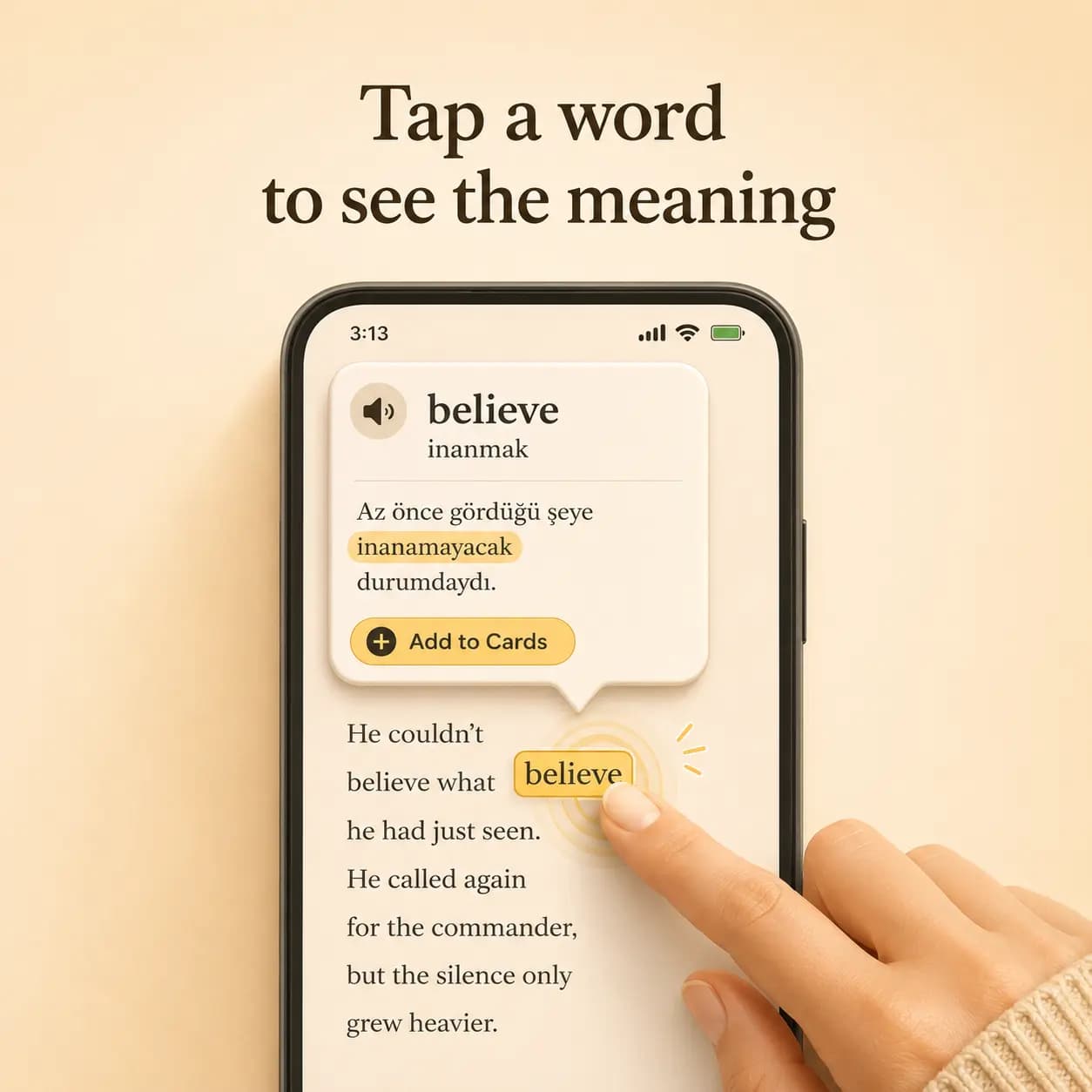
- When you meet an unknown word, look it up in context rather than in a long dictionary entry. In the Okuzeka reader you tap the word and see what it means in that sentence.
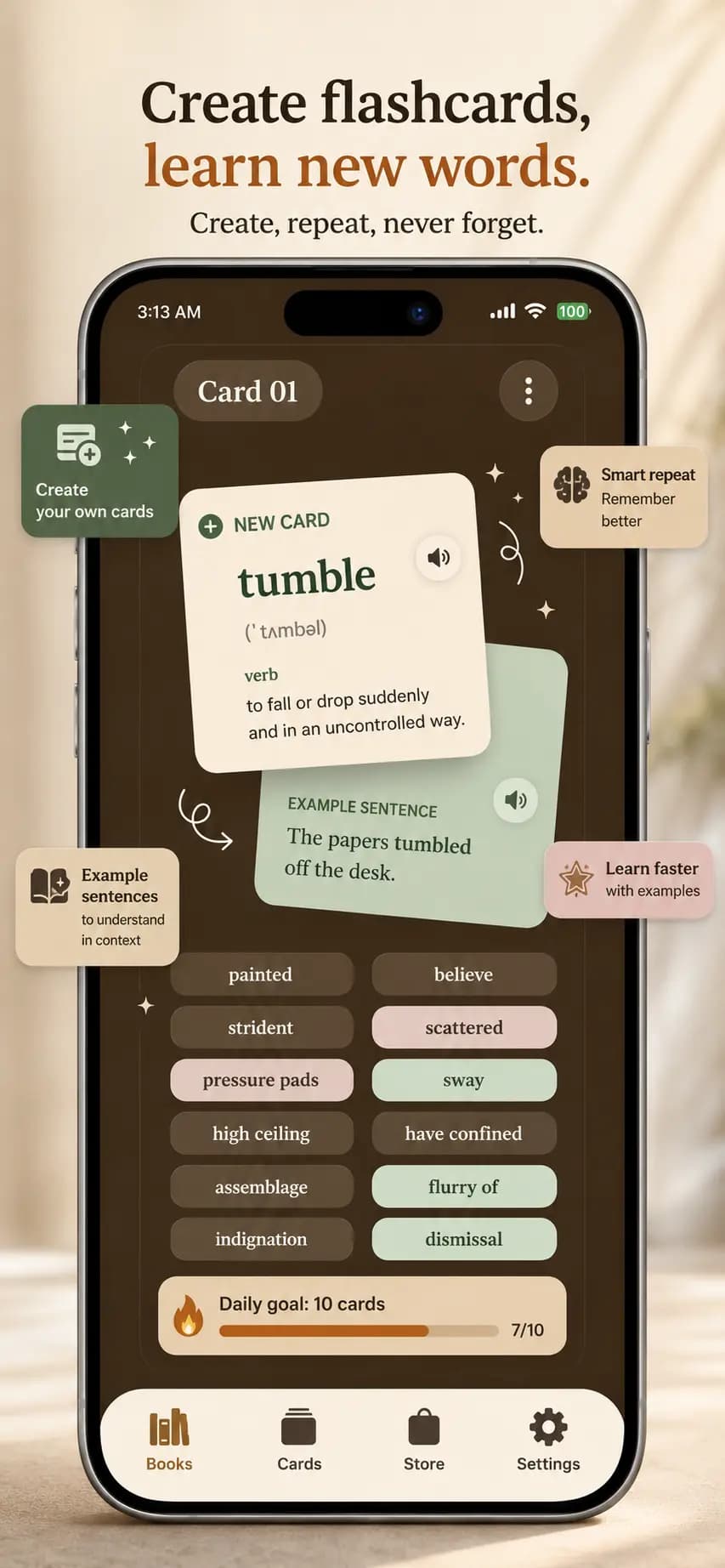
- Save the words you want to keep. A word reviewed a few times with its original sentence is far more likely to stick than one copied into a list.
- Retake this test every two or three months. Vocabulary grows slowly, so compare results over months, not days.
Methodology and limitations
The word ranking comes from wordfreq, which combines frequencies from Wikipedia, film and TV subtitles, news, books and web text. Inflected forms were merged into lemmas, names and non-words were removed, and every test word was checked by hand to exclude names, offensive words and inflected forms.
A yes/no test measures recognition: whether you know a word when you see it. It does not test whether you can use the word in your own speech or writing, which is usually a smaller number. The estimate also depends on honest answers; the made-up words reduce, but cannot remove, the effect of guessing.
Because the test stops at the 20,000th word, very large vocabularies are capped at 20,000. Educated native speakers know far more: Brysbaert and colleagues (2016) estimated that an average 20-year-old native speaker of American English knows about 42,000 lemmas.