Why learn the most common words first?
English has hundreds of thousands of words, but a small core does most of the work. In our measurements, the 1,000 most frequent lemmas make up about 80–84% of the running words in a classic novel such as Pride and Prejudice or Alice's Adventures in Wonderland, and the 3,000 most frequent about 90–92%.
That is why every course starts with these words, and why a learner who knows them well can already follow a lot of simple English. Each word you learn from this list pays off on almost every page you will read.
| Text | Top 1,000 | Top 2,000 | Top 3,000 | Top 5,000 |
|---|---|---|---|---|
| Alice's Adventures in Wonderland | 84% | 90% | 92% | 95% |
| Pride and Prejudice | 80% | 86% | 90% | 93% |
| Short B1 text (sample) | 78% | 88% | 95% | 98% |
| Academic C1 text (sample) | 60% | 69% | 74% | 88% |
The last row shows the limit of any frequency list: academic and specialist texts lean on less common words, which is where level-specific lists such as the B2 and C1 word lists take over.
How this list was made
The ranking comes from wordfreq, which combines word frequencies from Wikipedia, film and TV subtitles, news, books and web text, so it reflects both written and spoken English. Inflected forms were counted together with their base form (went and going count as go), and names, abbreviations, slang and swear words were removed.
Each word shows its most common parts of speech and its CEFR level from the CEFR-J Wordlist (A1–B2) or the Octanove Vocabulary Profile (C1–C2). Words such as the, of and to have no translation of their own; they are learned in phrases, not alone.
How to learn the 1,000 most common words
- Take the one-minute test above to see roughly how many you already know.
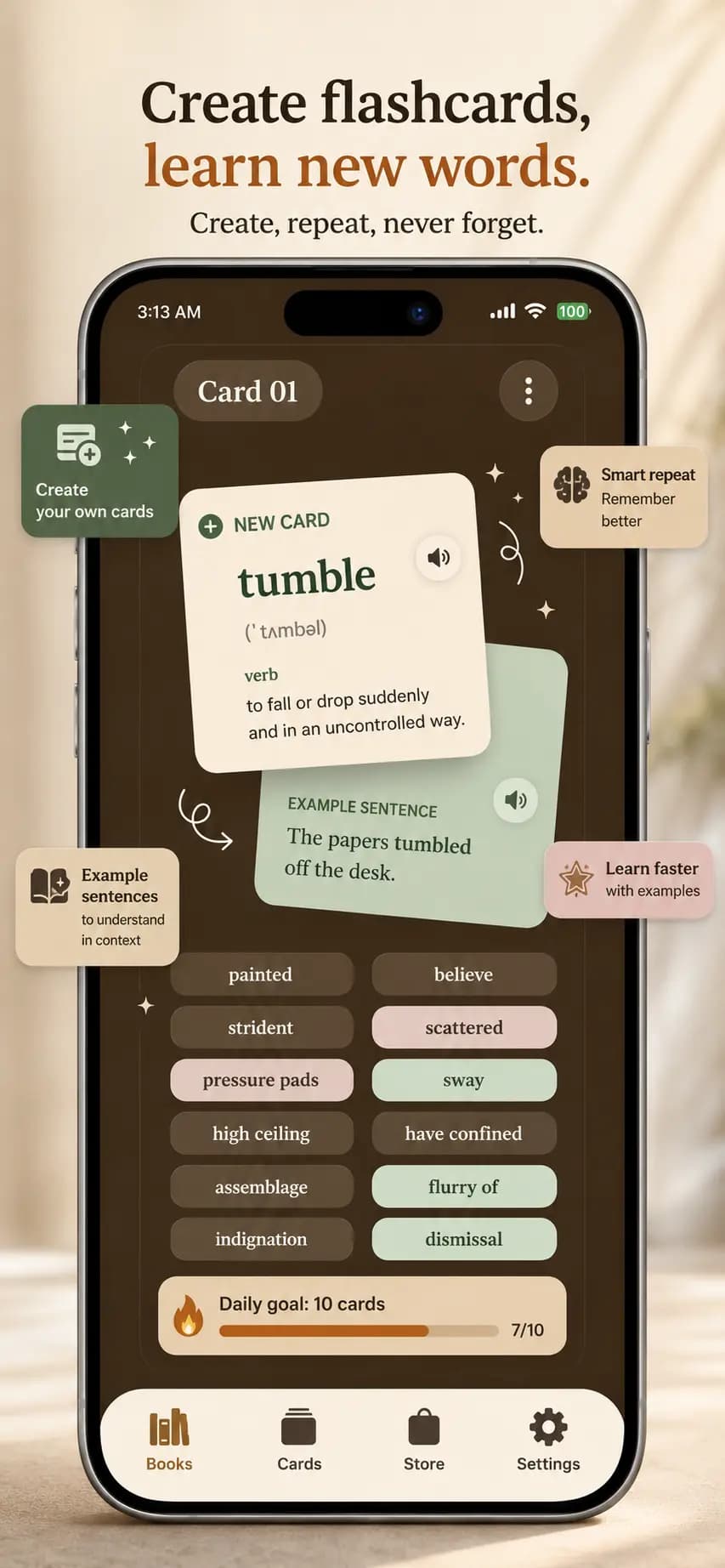
- Go through the list with the search and level filters, and copy the words you don't know into your flashcards.
- Learn in small daily batches of 10–20 words, reviewing earlier ones as you go.
- Read very easy books. Common words repeat on every page, which is exactly the repetition memory needs. Start with A1 and A2 English books on Okuzeka and tap any word you don't know.
- When the first 1,000 feel easy, switch the list to 2,000 and 3,000 words.
Most common words and CEFR levels
Most of the top 1,000 words are A1 or A2, but not all of them. Words such as issue, policy or federal are very frequent in news and online text even though learners usually meet them at B1 or B2. That is why this list shows both: frequency tells you how useful a word is, the CEFR level tells you when learners typically learn it.
For a list organised by level instead of frequency, use the A1–C2 vocabulary lists.