See what a word means in this sentence
A dictionary can give ten possible answers. Okuzeka starts from the sentence in front of you and explains the meaning that actually fits.
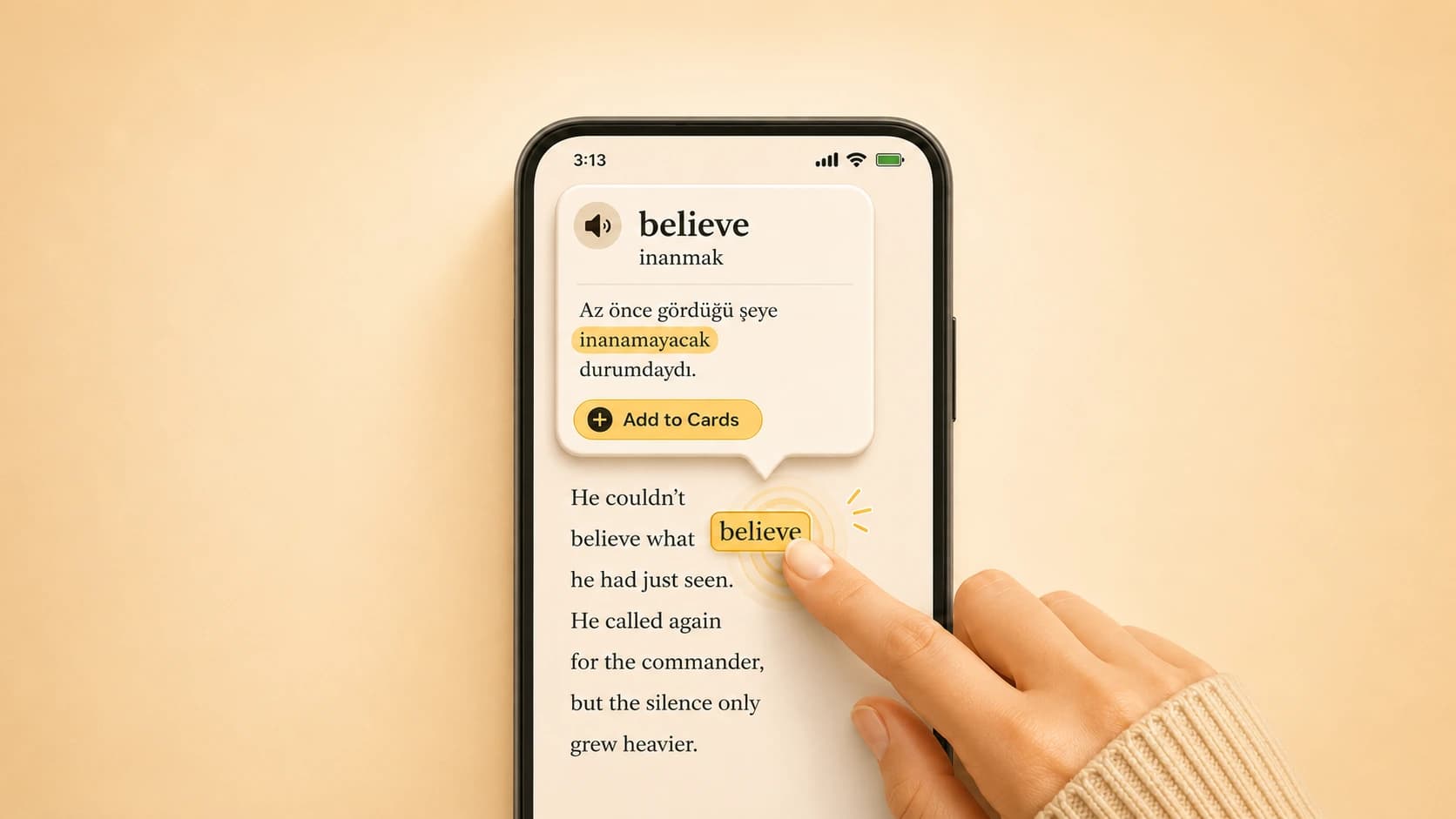


Get contextual word meaning while reading PDFs and books. Okuzeka explains words, phrases, idioms, and translations based on the sentence you are reading.
When people search for contextual word meaning, they usually want the meaning of a word in a specific sentence, not a long list of dictionary possibilities. Okuzeka is built for that exact reading problem.
You tap a word or phrase inside the reader, and the explanation is written around the sentence you are reading. That helps you understand the author's meaning instead of stopping to compare several unrelated translations.
Okuzeka explains a selected word by looking at how it is used in the current sentence. That makes the answer feel closer to what the author meant.
You do not need to open a dictionary, compare several meanings, and decide alone. The reader gives you a focused explanation where you are already reading.
This matters most with words that look familiar but behave differently in a particular passage. Context helps separate the meaning that fits from the meanings that only belong somewhere else.
Many confusing moments are not single-word problems. Idioms, phrasal verbs, collocations, and figurative language often need phrase-level explanation.
Okuzeka is built for those moments, so the answer can explain the expression instead of translating each word separately.
For language learners, this makes a big difference. A phrase like a verb plus a small preposition can carry a meaning that disappears when the words are treated one by one.
A word becomes easier to remember when you first understand it inside a real sentence. After the meaning is clear, you can save the word for later review.
Your vocabulary list becomes a record of words you actually met while reading, not a random list detached from context.
That also keeps review more honest. If a word never mattered inside a book, it probably does not deserve the same attention as a word that appeared in a sentence you truly wanted to understand.
Many reading problems are phrase problems. Phrasal verbs, idioms, fixed expressions, and collocations can become confusing when each word is translated separately.
Okuzeka can explain the selected word as part of the larger expression when the sentence requires it. That is especially useful for English learners, but the same problem exists across many languages.
Designed for real reading moments where direct translation is not enough.
Designed for real reading moments where direct translation is not enough.
Designed for real reading moments where direct translation is not enough.
The best time to save a word is after it becomes clear. Okuzeka lets you understand a word in context first, then add it to your vocabulary cards if it is worth reviewing.
That creates a more natural learning loop: read, notice a word, understand it in the sentence, save it if useful, and continue. Your vocabulary grows from real reading rather than disconnected lists.
It means understanding a word based on how it is used in a particular sentence. Instead of choosing the first dictionary definition, Okuzeka looks at the surrounding text and explains the meaning that fits that passage.
A dictionary can list possible meanings, but it usually does not know which meaning belongs to your exact sentence. Context matters because words can be literal, figurative, technical, emotional, or part of a phrase.
Okuzeka is designed to detect expressions and phrase-level meanings when the surrounding context suggests that a literal word-by-word answer is not enough.
Not exactly. Translation can be part of the answer, but contextual meaning also explains what the word or phrase is doing in the sentence. That is why it is often more useful than a direct one-word translation.
Yes. If the meaning lives in a phrase, expression, or group of words, selecting the phrase can produce a clearer answer than selecting only one word.
Yes. Contextual meanings work inside the Okuzeka reader, including uploaded PDFs when the text can be extracted cleanly.
Yes. Okuzeka supports EPUB reading as well as PDFs and books from the catalog.
Yes. You can read in one language and receive meanings in the native language you choose.
No. English is a common use case, but contextual meaning is useful across many language pairs and even for difficult texts in your own language.
It can be. AI explanations are reading assistance, not a perfect authority. Ambiguous passages, poor text extraction, technical writing, and unusual language can still need human judgment.
Yes. If a word is useful, you can save it as a flashcard from the reading flow and review it later.
No. The point of Okuzeka is to keep the lookup inside the reader so you do not break your reading flow.
Yes. The Starter plan lets you begin for free with a small library and a monthly word query limit. Paid plans are available for heavier use.