Learn languages by reading books you actually want
Okuzeka turns real books into language practice. Read, tap words you do not know, understand them in context, and save useful vocabulary for later.

Read books to learn languages with context-aware meanings, phrase explanations, translations, and vocabulary flashcards from real books, PDFs, and EPUBs.
People often search for how to read books to learn languages because they are tired of isolated exercises. Books give you vocabulary, grammar, repetition, tone, and motivation in one place.
Okuzeka makes that approach easier. You can read books from the catalog or upload your own PDF, then turn unknown words and phrases into learning moments without leaving the page.
Okuzeka lets you learn from the content you want to read. You can open books from the catalog or bring your own PDF into the reader.
That makes language learning more personal. A story, classic, article, or study text can become your practice material.
You are not locked into one course path or one set of sample sentences. If the subject keeps you curious, the reading habit has a better chance of becoming consistent.
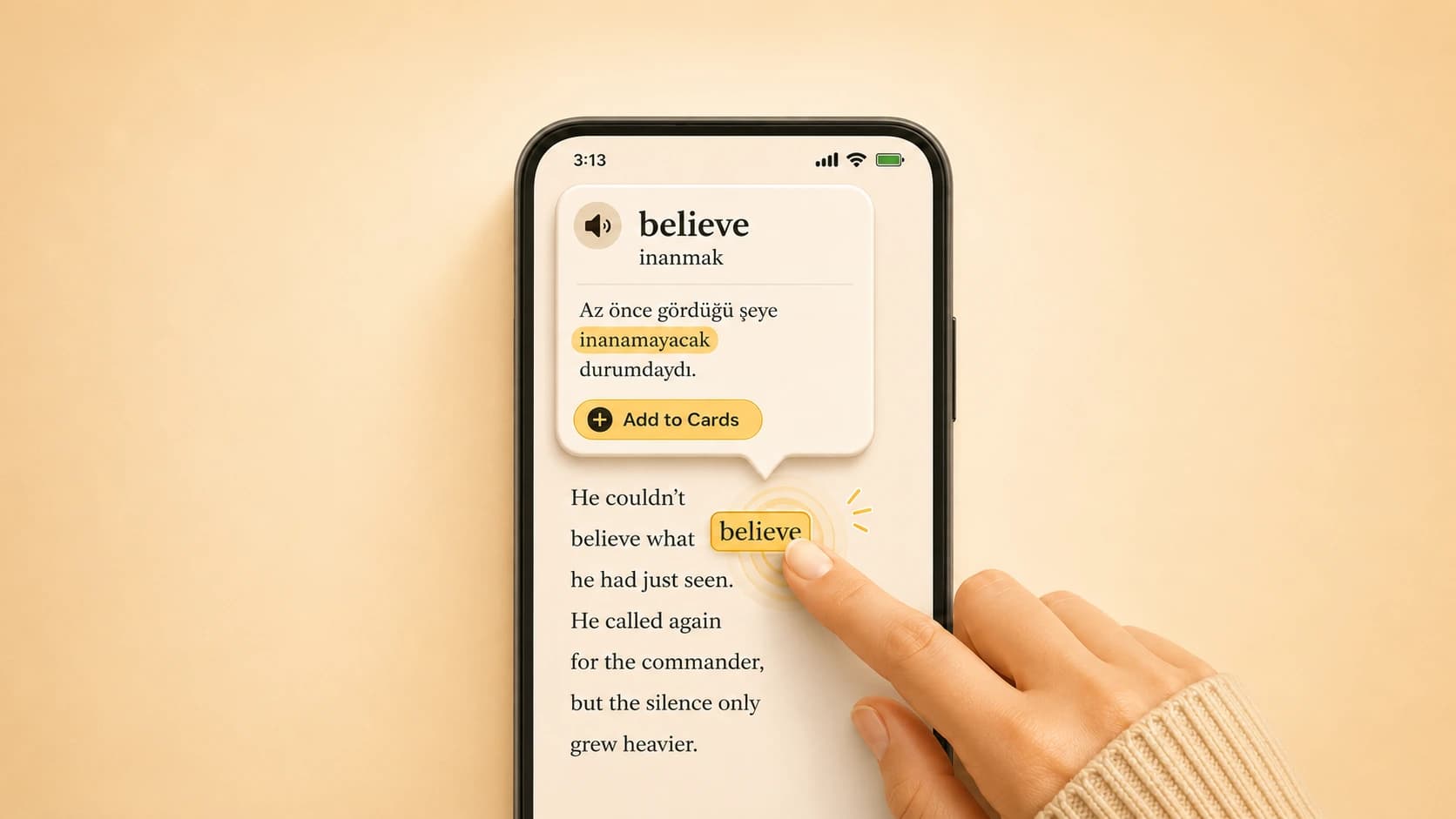
You do not have to stop reading for every unknown word. When a word or phrase blocks the sentence, you tap it and get a contextual explanation.
This creates a calmer reading rhythm: understand enough to continue, save important vocabulary, and slowly grow confidence with real texts.
That balance is important. Too many lookups can make reading feel like homework, but the right lookup at the right moment can keep the story or argument moving.
Words learned from books come with examples built in. You see the word in action, not as a standalone translation.
When you save those words as cards, review is tied to the language you actually encountered while reading.
As chapters accumulate, repeated words and phrases start to feel familiar. That is where book-based learning becomes powerful: the language returns naturally instead of being forced into isolated drills.
A common mistake is stopping for every unfamiliar word. Better reading practice often means understanding enough to continue, then saving the words that really matter.
Okuzeka supports that rhythm. When a word blocks the sentence, tap it, read the contextual meaning in your native language, and keep going.
Useful when you want language practice to come from stories and subjects you already care about.
Useful when you want language practice to come from stories and subjects you already care about.
Useful when you want language practice to come from stories and subjects you already care about.
A book repeats words naturally across chapters, characters, topics, and scenes. That repetition is powerful because you see how language behaves in real context.
When you save useful words as flashcards, your review deck becomes a record of your actual reading. You learn while reading, then strengthen what you learned later.
Yes, reading can be a powerful part of language learning because it gives you vocabulary and grammar in real context. It works best when the book is understandable enough and you have help for difficult words and phrases.
You do not need to be perfect, but the book should not be impossible. Many learners do best with material where they understand the general meaning and need help with some words, phrases, or sentences.
No. You can upload your own PDFs and learn from the exact content you want.
Yes. Okuzeka supports EPUB reading as well as PDFs and books from the catalog.
Yes. Okuzeka supports many languages for reading and contextual explanations.
Yes. You can choose the native language you want meanings in, then read in the language you are learning.
Okuzeka is focused on helping you read and learn, not replacing the whole book with a full machine translation. It is strongest when you ask for help on the words, phrases, or sentences that block understanding.
Usually no. Looking up every word can make reading feel slow. A better habit is to look up words that block the meaning, repeat often, or seem useful enough to save.
Yes. When a word is worth remembering, you can save it to vocabulary cards while reading and review it later.
They solve different problems. Traditional apps are useful for structured practice. Reading books helps you meet real language in context. Okuzeka is built to make that book-based practice easier.
Choose books you actually care about and can partly understand. Stories, classics, essays, graded material, and nonfiction can all work if they keep you reading.
Beginners can use it with easier material, but complete beginners may still need basic lessons first. Okuzeka is especially useful once you can follow simple sentences and want to read more real content.
Yes. Okuzeka works on the web and is available on both the App Store and Google Play.
Yes. The Starter plan lets you begin for free with a small library and a monthly word query limit. Paid plans are available for larger libraries and heavier use.