Online English Level Test for A1, A2, B1, B2, C1 and C2
This free online English level test helps learners choose a practical starting point before selecting books, lessons, or a study routine. It is a grammar and vocabulary placement estimate, not an official language qualification, so please do not frame it next to a university diploma.
After the test, use your level to choose reading material that is challenging without secretly being a final boss. Start with A1 English stories or A2 English stories if you are building foundations, move toward B1 and B2 English books for intermediate growth, or explore C1 English books for advanced reading practice.
Why take an English level test before choosing material?
A good English level test saves you from the classic learner trap: opening a book that is either so easy it feels like a warm-up, or so difficult it starts looking at you personally. This online English level test gives you a practical A1, A2, B1, B2, C1 or C2 estimate before you spend time on the wrong course, reader, video series or vocabulary list.
The test focuses on grammar and vocabulary because those two areas are strong signals for placement. It cannot hear your pronunciation, admire your dramatic pauses, or judge your writing style, but it can quickly show whether beginner, intermediate or advanced material is likely to fit your current English level.
What to do after your result
- Pick reading material close to your estimated CEFR level.
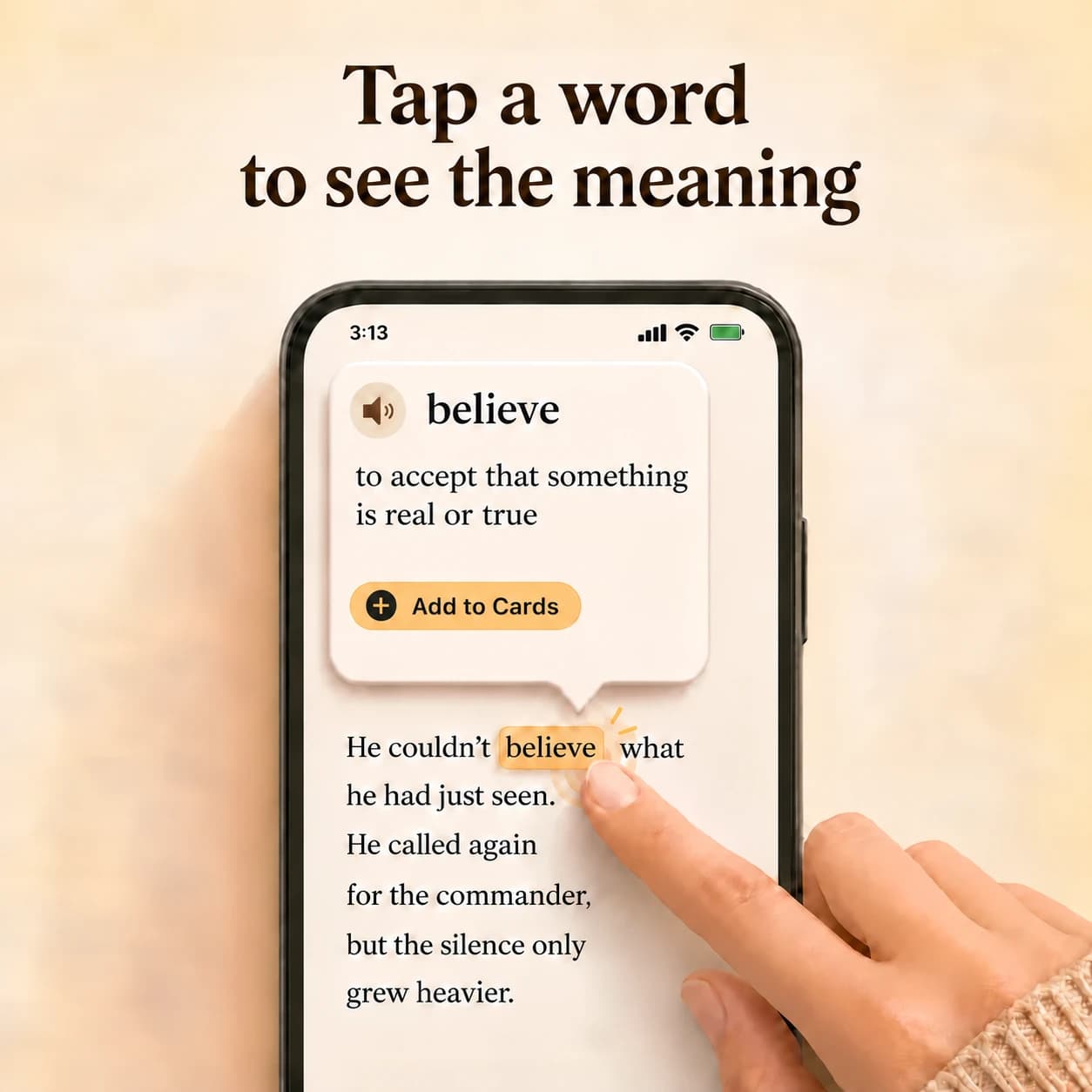
- Use contextual meanings when a word changes with the sentence.
- Save useful words as vocabulary flashcards while reading.
- Retake the test after several weeks of focused practice.
Which English Level Test Should You Take?
A fast A1-C2 snapshot from 20 questions — ideal when you want a direction in five minutes.
The recommended balance: 40 questions for a reliable A1-C2 result in about ten minutes.
The most thorough option: 120 questions and answer review for the clearest A1-C2 placement.
English levels explained: A1 to C2
The test places you on the six-level CEFR scale (Common European Framework of Reference for Languages) that schools, publishers and exam boards use. Here is what each level means for reading, and where to continue on Okuzeka once you know yours.
| Level | What you can read and understand | Read next |
|---|---|---|
| A1 Beginner | Familiar names, everyday words and very simple sentences: signs, labels, short notes and basic personal details. | A1 English stories |
| A2 Elementary | Short, simple texts on everyday topics: messages, menus, adverts and short stories written with common vocabulary. | A2 English stories |
| B1 Intermediate | The main points of clear texts on familiar subjects such as work, school and travel, and straightforward connected stories. | B1 English books |
| B2 Upper-intermediate | Articles, reports and contemporary novels with a good degree of independence, including different opinions and lines of argument. | B2 English books |
| C1 Advanced | Long, demanding texts, including literary and specialised writing, together with their implied meaning, style and nuance. | C1 English books |
| C2 Proficient | Virtually any written English with ease, including abstract, structurally complex or highly idiomatic texts. | C2 English books |
How the test measures each level band
There is no separate exam for each level. Every Okuzeka English placement test mixes multiple-choice grammar and vocabulary questions from all six CEFR levels, and your overall score decides where you land. This is what each band checks and what to read once you are there.
A1–A2 placement: how beginner levels are measured
A1 and A2 questions check the foundations: the verb to be, there is and there are, present and past simple, can and must, articles, pronouns, prepositions of time and place, comparatives, and everyday vocabulary in short sentences and mini dialogues.
8 of the 20 questions in the 5-minute test, 14 of the 40 questions in the 10-minute test and 40 of the 120 questions in the 30-minute test come from these two levels. A result of A1 or A2 means your total score stayed in the lower part of the scale: roughly the bottom fifth is A1 and scores approaching 40 percent are A2.
Read next: A1 English stories and A2 English stories.
B1–B2 placement: how intermediate levels are measured
B1 and B2 questions move on to longer, less predictable sentences: present perfect and past perfect, conditionals and wishes, the passive and reported speech, relative clauses, modal verbs for deduction, verb patterns, phrasal verbs, the prepositions that go with common words, and the first word-meaning questions.
6 of the 20 questions in the 5-minute test, 14 of the 40 questions in the 10-minute test and 40 of the 120 questions in the 30-minute test come from these two levels. Scores up to the mid-fifties in percent are placed at B1 and scores up to about 70 percent at B2. For B2 the test also expects about half of the B2-level questions to be right; otherwise the result is shown as B1+.
Read next: B1 English books and B2 English books.
C1–C2 placement: how advanced levels are measured
C1 and C2 questions test precision rather than rules you can memorise: inversion and emphasis, formal conditional and subjunctive structures, linking words with fine shades of meaning, fixed expressions and idioms, and low-frequency vocabulary where only one option fits the tone of the sentence.
6 of the 20 questions in the 5-minute test, 12 of the 40 questions in the 10-minute test and 40 of the 120 questions in the 30-minute test come from these two levels. Scores up to the mid-eighties are placed at C1 and anything above that at C2, but only when enough of the C1 or C2 questions themselves are right; otherwise the result is shown as B2+ or C1+.
Read next: C1 English books and C2 English books.
How to Read Your English Level Test Result
Treat the result as a placement guide, not a personality diagnosis. If the online English level test says A2, it means elementary material may be a better starting point than a C1 novel with tiny print and zero mercy. If it says B2 or C1, you can probably handle more authentic reading, but targeted vocabulary review will still pull its chair up and join the conversation.
Your English level can also change by skill. Some learners read at B2 but speak closer to B1; others know grammar rules but freeze when a sentence starts moving at real-world speed. Use this English level test result together with reading, listening, speaking and writing practice for a fuller picture.
English Level Test Results by CEFR Level
A1-A2 English Level Test Result
You are building the core engine: everyday words, simple grammar, short sentences and survival phrases. Choose graded readers and clear beginner lessons.
B1-B2 English Level Test Result
You can work with longer texts, opinions and real conversations. This is where reading regularly starts paying rent instead of just visiting.
C1-C2 English Level Test Result
You are refining precision, tone, collocations and advanced vocabulary. The goal is no longer just understanding English; it is choosing the right English on purpose.
English Level Test FAQ
Is this a free English level test no sign up?
Yes. Choose the 5-minute, 10-minute or 30-minute free English level test and start without creating an account.
Does the test cover every English level?
The question bank covers the CEFR range from A1, A2, B1 and B2 through C1 and C2.
Is the certificate official?
No. It records an estimated result from this online placement test and is not an accredited qualification.
How accurate is the English level test?
It gives a practical grammar and vocabulary estimate. For a more complete picture, combine it with speaking, listening and writing practice.
Can I use this English level test on mobile?
Yes. The test works in the browser on phones, tablets and desktops, so your English level can be discovered without negotiating with a giant screen.
How often should I retake the English level test?
Retake it after several weeks of study. Repeating it immediately mostly measures memory, which is useful, but not the same as progress.
What is the difference between A1 and A2?
A1 is the beginner level: you understand familiar words and very simple sentences and can introduce yourself briefly. At A2 you can read short texts on everyday topics and talk about the past and your plans in simple sentences. In the test your total score separates the two: roughly the bottom fifth of the scale is A1 and scores approaching 40 percent are A2.
How many questions are in the test and how long does it take?
It depends on the length you choose: the 5-minute test has 20 questions, the 10-minute test has 40 questions and the 30-minute test has 120 questions. All of them are multiple-choice grammar and vocabulary questions, and your result appears on screen as soon as you answer the last one or the time runs out.
Is this an official English exam?
No. It is a free, independent online test made by Okuzeka. It is not a school or ministry exam, and it is not an official test such as Cambridge English, IELTS or TOEFL. The result and the optional certificate show an estimated level and are not accepted as proof in official applications. It works well as practice before a school or course placement test.