

5-Minute English Level Test: Free, No Sign-Up, Instant CEFR Result
The 5 minute English level test is the fastest way to find out where your English stands. With 20 mixed-level grammar and vocabulary questions, it estimates your CEFR level from A1 to C2 — completely free, in your browser, with no sign-up and no email required. Your result appears the moment you answer the last question, along with an optional certificate of your estimated level. Use it as a quick snapshot before choosing books, courses, or a longer, more detailed placement test.
How does the 5-minute English level test work?
The test presents 20 multiple-choice grammar and vocabulary questions drawn from every CEFR band, and your answer pattern determines your estimated level from A1 to C2. Questions are mixed in difficulty, so beginners and advanced learners take the same short quiz. There is nothing to install and no account to create: open the page, tap start, and answer at your own pace — most people finish in about five minutes. When you submit the final answer, your CEFR estimate appears instantly on screen. You can then download an optional certificate showing your estimated level, or move straight on to learning material that matches it.
Can 20 questions really place you on the CEFR scale?
Your CEFR level is calculated from your placement score across all 20 questions and mapped onto six bands from A1 to C2. Roughly speaking, the lowest fifth of the scale indicates A1, scores up to about the middle point to A2 or B1, stronger results map to B2 and C1, and scores above roughly 85 percent land in C2. You do not need a perfect score to reach the top levels. The bands follow the CEFR framework used by schools and publishers worldwide, so your result translates directly into course levels, exam preparation tiers, and graded readers — the same scale wherever you use it.
Who is the 5-minute English test for?
The 5-minute test is for anyone who needs a quick, reliable direction rather than a detailed diagnosis. It suits learners choosing their first graded reader or course, students checking whether their level has changed after a study period, job applicants who want a fast self-check before an interview, and returners to English who have no idea where to start. It is also the easiest short English test online for busy people: no sign-up, no email, and a result before your coffee cools. If you need a finer-grained profile — for example, to plan an exam strategy — start here, then confirm with the 30-minute test.
5 vs 10 vs 30 minutes: which English test should you choose?
Choose the 5-minute test when speed matters most: it gives a solid CEFR direction from 20 questions and works well as a first snapshot. The 10-minute test asks more questions for a steadier estimate — a good middle ground if you have a few extra minutes. The 30-minute test is the most thorough, covering more question types and giving the most stable placement; pick it before enrolling in a course or setting an exam target. All three are free, work without sign-up, cover A1 to C2, and show instant results, so a practical approach is to start with 5 minutes and verify with a longer test if the outcome surprises you.
What should you do after your result?
Treat your result as a starting point: pick learning material at your level, or one notch below for comfortable reading. A quick English level test is a snapshot, so if your score sits near a band boundary, retake it another day or confirm with the longer 30-minute version. Download the optional certificate if you want a record — it is an estimate of your level, not an accredited qualification. The most effective next step is regular input at the right difficulty: on Okuzeka you can open a book matched to your CEFR level, tap any word to see its meaning in context, and save it as a flashcard.
What does a five-minute English test measure — and what does it leave out?
A short online placement test is strongest at checking recognition: whether you can identify a natural sentence, choose the form that fits a context, understand common vocabulary and notice differences between easier and more advanced grammar. Those signals are useful because they influence almost every reading task. Twenty mixed questions can show whether beginner, intermediate or advanced material is likely to feel comfortable. However, the result is still an estimate. A multiple-choice test cannot listen to your pronunciation, observe a real conversation, evaluate an extended piece of writing or measure how confidently you understand fast speech. Your reading level may also be higher than your speaking level, or the other way around. Use the score as a practical placement clue rather than a permanent label. If you need a decision for university admission, immigration or employment, check which supervised examination the relevant organisation accepts. If you simply need to choose a book, course or study routine, the quick result gives you a useful place to begin without demanding an hour of your day.
How to prepare for five focused minutes
You do not need to revise before taking the test, but a small amount of preparation makes the result more meaningful. Choose a quiet moment, close translation tabs and put your phone on silent unless you are using it to take the assessment. Read every complete sentence before looking at the options. Grammar questions often contain a time expression, preposition or surrounding phrase that changes the correct answer. Work steadily instead of racing the timer; five minutes is the expected length, not a demand to guess quickly. If you do not know an answer, make the most reasonable choice and continue. Avoid searching for the rule because the purpose is to see what you can recognise independently today. It is also better not to repeat the assessment immediately after finishing. A second attempt taken a few minutes later may measure memory of the questions rather than improvement in English. Save the result, study consistently, then return after several weeks if you want a fairer comparison.
Why honest answers matter more than a perfect score
A placement result is only useful when it reflects your current working knowledge. There is no prize for appearing advanced and no penalty for meeting questions you cannot answer. The test deliberately mixes familiar and difficult language so that it can locate the point where your accuracy begins to fall. A beginner is not expected to solve C1 or C2 items, and an advanced learner can still miss an easy question through distraction. Choose the answer you genuinely believe is correct, but do not use a dictionary, translator or AI assistant during the assessment. External help may raise the number on screen while sending you toward books and lessons that are frustratingly difficult. An honest B1 estimate is far more valuable than an assisted C1 score because it leads to material you can understand, enjoy and learn from. Think of the result as a map marker: its job is to help you choose the next sensible route. The best score is therefore not the highest possible score; it is the clearest picture of what you can do on your own.
How to interpret a result near a CEFR boundary
Language ability does not change suddenly at an exact line between A2 and B1 or between B1 and B2. CEFR bands describe broad ranges of performance, and a short test samples only part of that performance. If your result is close to a boundary, treat both neighbouring levels as useful information. For example, an A2 learner approaching B1 may read comfortable A2 stories independently while trying selected B1 texts with contextual support. A learner near B2 can combine B1 material for fluency with more demanding B2 articles and books for growth. Concentration, sleep, familiarity with a topic and a few lucky or unlucky choices can move a quick score. That does not make the result meaningless; it means the estimate should be interpreted with proportion. Compare it with real tasks: Can you follow the main idea of an article? Can you read a chapter without translating every sentence? Can you explain an opinion in connected language? If the estimate and your daily experience disagree, take the 10-minute or 30-minute version on another day and look for the level that appears consistently.
A practical next step after an A1 or A2 result
An A1 or A2 result means you are building the high-frequency core of English. This is the stage for useful everyday vocabulary, common sentence patterns, basic verb forms and short texts with clear context. Choose graded stories where you understand most of each page and only need occasional help. Reading material that is too difficult can turn every paragraph into a translation exercise, while material at the right level lets repeated words and structures become familiar naturally. At A1, focus on introductions, daily routines, family, food, places, time and simple present or past events. At A2, add longer descriptions, travel situations, plans, comparisons and short connected narratives. When you meet an unfamiliar word, first use the sentence to guess whether it is a person, action, object or description. Then check its contextual meaning and save only the words you are likely to meet again. A small collection of useful vocabulary reviewed regularly is more effective than hundreds of isolated terms. As reading becomes smoother, try a slightly harder book and notice whether you can follow the story without losing the main idea.
A practical next step after a B1 or B2 result
B1 and B2 learners are moving from controlled learner material toward independent use of English. At B1, you can usually follow the main points of clear texts about familiar subjects, describe experiences and understand a connected story even when some details are missing. Build fluency by reading regularly and resisting the urge to stop at every unknown word. Mark words that block the main idea, check them in context and continue. At B2, authentic novels, articles and professional material become more realistic, although idioms, phrasal verbs and dense passages may still require support. Vary the type of English you read: combine fiction with essays, news analysis, biographies or material related to your work. Pay attention to collocations and complete phrases rather than collecting single words only. A phrase such as “raise a concern” is more useful than memorising “raise” and “concern” separately. Review saved vocabulary in the original sentence so that meaning, grammar and tone stay connected. If the five-minute result places you at B1 or B2, choose one achievable reading project and finish it; sustained exposure usually teaches more than repeatedly starting material that looks impressive but never becomes a habit.
A practical next step after a C1 or C2 result
A C1 or C2 estimate suggests that basic comprehension is no longer the main challenge. Progress now depends on precision, range, style and the ability to handle specialised or subtle language. Read across genres and purposes: literary fiction for voice and implication, long-form journalism for argument, professional writing for concise terminology, and essays for structure and tone. Notice why an author chooses one near-synonym instead of another, how a paragraph signals contrast, and which expressions belong to formal, informal or ironic contexts. Advanced learners still benefit from vocabulary cards, but the cards should capture rich examples, collocations and shades of meaning rather than simple translations. Test new expressions by using them in a sentence of your own. A high result on a short recognition test does not automatically prove equally strong speaking or writing, so create output as well as input: summarise a chapter, explain an argument aloud or rewrite a paragraph in a different register. If you need formal evidence of proficiency, use a recognised supervised exam. Use the Okuzeka estimate to guide daily learning, not to replace official certification.
Why reading in context turns a test score into progress
A level estimate becomes valuable only when it changes what you do next. Reading is one of the most efficient ways to turn that estimate into repeated contact with grammar and vocabulary at the right difficulty. In a book, words appear inside characters, actions, arguments and consequences; those connections make language easier to remember than an isolated list. Context also reveals why a familiar word has a different meaning in a new sentence, or why a phrasal verb cannot be translated word by word. Okuzeka keeps that learning loop inside the reader. You can open a catalog book or upload a supported PDF or EPUB, tap an unfamiliar word or phrase, see the meaning it has in that sentence and save useful vocabulary as a card. Notes, reading progress and adjustable typography help you stay with the book instead of moving between unrelated tools. Choose a text close to your estimated CEFR level, read a manageable amount each day and review a small number of high-value words. After several weeks, retake the test and compare the result with something even more important: whether real pages feel clearer, faster and more enjoyable.
Ready to find your level?
Answer 20 questions and get your estimated CEFR result on screen.
After your result
- Pick reading material close to your estimated CEFR level.
- Tap difficult words to see their meaning in context.
- Save useful words as vocabulary flashcards.
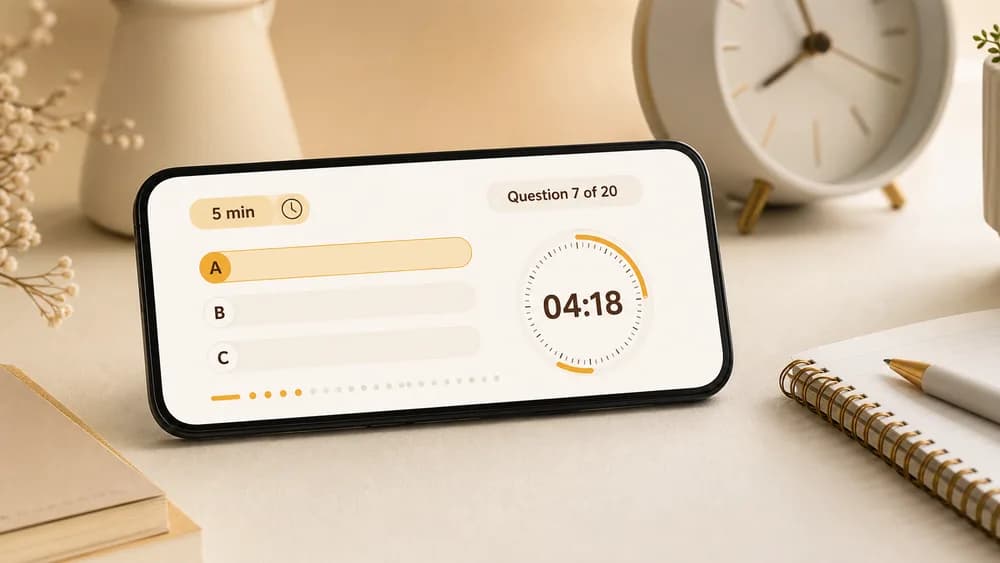
Know exactly what happens after you press Start
The assessment opens directly on the first question. A visible timer, progress line and answered-question count keep the experience clear without turning a five-minute check into a stressful exam. Each answer moves the test forward, and you can leave the assessment at any time.
How to take the 5-minute English level test
- 1. Open the test page
Go to the 5-minute English level test in any browser. No download, sign-up, or email is needed.
- 2. Answer 20 quick questions
Work through the mixed grammar and vocabulary questions at your own pace. If you are unsure, pick the closest answer and keep moving.
- 3. See your level instantly
Your CEFR estimate from A1 to C2 appears on screen right after the last question.
- 4. Download your optional certificate
Save a certificate showing your estimated level. It is a self-assessment record, not an accredited document.
- 5. Start learning at your level
Use your result to pick books or courses at the right difficulty, or verify it with a longer test.
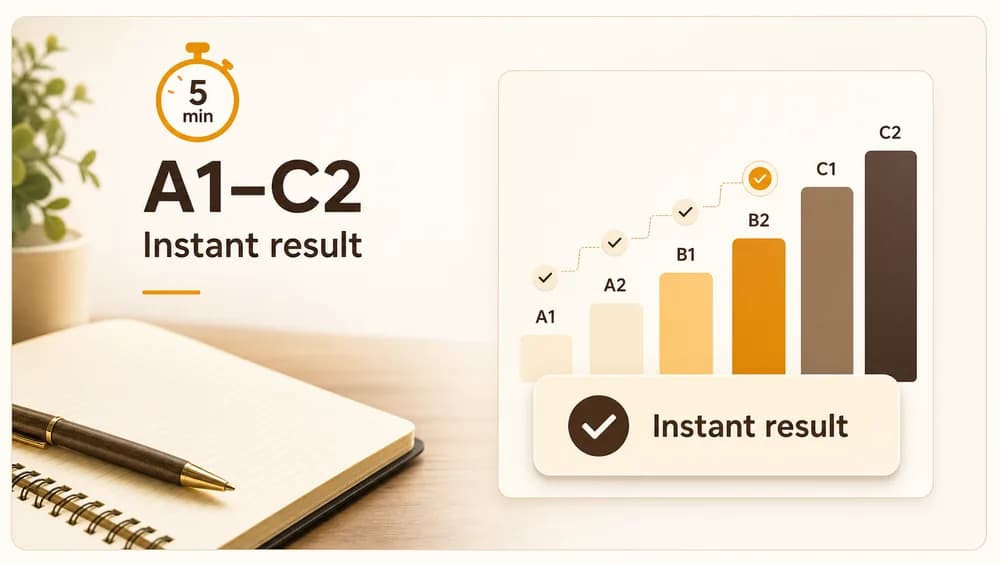
Turn the score into a useful next step
When the final answer is submitted, Okuzeka shows an estimated CEFR level and a clear score summary. Use that estimate to choose a suitable reader, review the answers you missed and decide whether a longer placement test would give you more confidence.
Prefer a different length?
Questions about this test
Is the 5-minute English level test free?
Yes, it is completely free. There is no payment, trial, or hidden fee, and you do not need to create an account or enter an email address to take the test or see your result.
How accurate is a 5-minute English test?
It gives a reliable direction, not a detailed diagnosis. Twenty mixed-level questions are enough to place most learners within one CEFR band. For a more stable estimate, confirm your result with the 10- or 30-minute test.
Do I get a certificate at the end?
Yes, an optional certificate is available after the test. It states your estimated CEFR level and is useful as a personal record, but it is not accredited and is not accepted as official proof of proficiency.
Can I take the test on my phone?
Yes. The test runs in any modern browser on phones, tablets, and computers, with no app to install. Twenty multiple-choice questions work comfortably on a small screen.
Can I retake the test?
Yes, as many times as you like, free of charge. Retaking after a period of study is an easy way to check progress; leave some time between attempts so you measure learning, not memory.
What does my CEFR result mean?
It places you on the six-level European scale: A1–A2 are beginner levels, B1–B2 independent, and C1–C2 advanced. Use it to choose courses, graded readers, and exam targets that match your current ability.
How is this different from the 10- and 30-minute tests?
It is the fastest option: 20 questions for a quick snapshot. The 10-minute test asks more questions for a steadier estimate, and the 30-minute test gives the most thorough placement. All are free with instant CEFR results.
Find your English level in about 5 minutes
No payment, account or email is required. Answer independently for the most useful estimate.