What the poem contains that a film cannot
Homer's Odyssey is not a straight adventure sequence. The first four books barely feature Odysseus at all: they follow his son Telemachus, who has grown up without a father while suitors occupy the family home and consume its wealth. The poem opens in a domestic crisis, not on a monster-filled sea.
The famous episodes — the Cyclops, Circe, the Sirens, Scylla and Charybdis, the descent to the underworld — arrive in books nine through twelve, and Odysseus tells most of them himself, as a guest recounting his past at a banquet. That framing is one of the oldest examples of unreliable first-person narration in Western literature, and it is the kind of structural detail that reads very differently on the page than on screen.
The final third of the poem is not a voyage at all. It is a long, tense sequence of disguise, testing, and recognition inside Odysseus' own house. Many readers find these closing books the most surprising part, precisely because popular retellings tend to stop at the sea monsters.
Which translation should you read?
This is the most common question after the film, and the honest answer is that it depends on what you want. Christopher Nolan has pointed readers to Emily Wilson's 2017 translation, which is written in plain, fast-moving iambic pentameter and is widely recommended for first-time readers. It is a modern, copyrighted work, so it is bought, not downloaded free.
Older translations — Butler, Pope, Chapman and others — are in the public domain and therefore free to read anywhere, including in Okuzeka. They differ enormously in feel: Pope's is rhymed and highly formal, Butler's is prose and much plainer. A free public-domain translation is the practical choice if you want to start reading in the next five minutes rather than waiting for a delivery.
There is no single correct answer, and many readers use both: a free version to read now, and a modern translation later if the poem grabs them. What matters far more than the edition is whether you have a way to handle the unfamiliar language when it appears.
Why Homer feels hard — and what actually helps
The Odyssey is rated at an advanced reading level for a reason. The difficulty is rarely the plot, which is straightforward once you know the cast. It is the texture: fixed epithets like 'rosy-fingered dawn', patronymics, invocations, formal similes, dozens of gods and place names, and older English vocabulary in the public-domain translations.
That combination punishes the usual coping strategy of pushing through and hoping context resolves it. When four or five unfamiliar terms stack up in one sentence, the sentence simply does not resolve, and readers quietly stop around the point where the ships leave Troy.
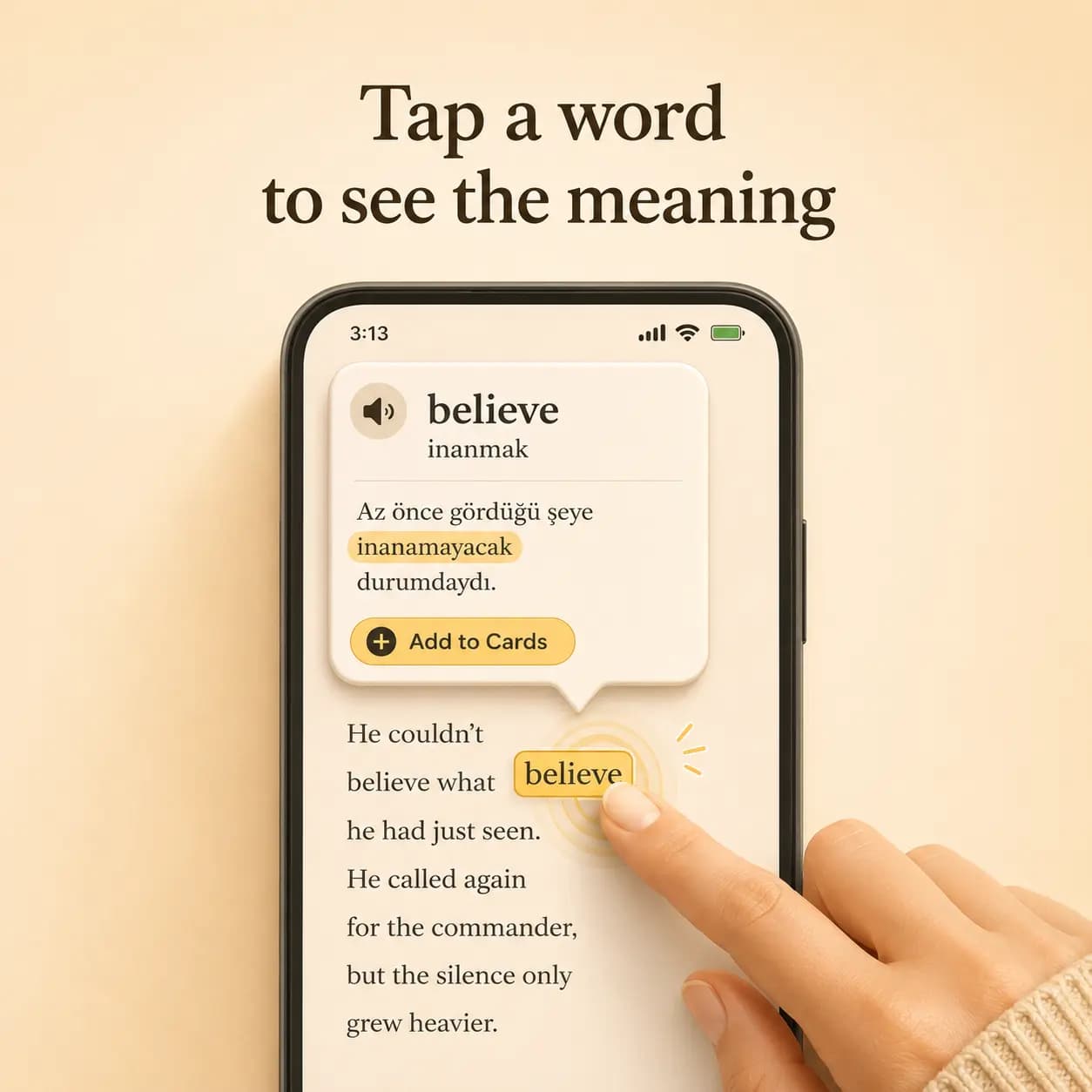
This is exactly the gap Okuzeka is built for. You tap the word or phrase that blocked the line, get a meaning based on that specific sentence rather than a generic dictionary entry, and keep going. Words worth remembering become flashcards; the rest you simply pass through. The goal is finishing the poem, not annotating it.
A realistic reading plan for all 24 books
Treat the 24 books as episodes rather than chapters. Most take twenty to forty minutes, and each has a self-contained shape, which makes the epic far more approachable than its page count suggests.
Books 1–4 introduce Telemachus and the situation at home; read these knowing that Odysseus is deliberately being withheld. Books 5–8 bring Odysseus onstage and deliver him to the Phaeacians. Books 9–12 are his own account of the voyage and contain nearly every episode you already know from the film. Books 13–24 return him to Ithaca in disguise and build to the confrontation with the suitors.
If you only have limited time, books 9–12 work as a self-contained run and are the single best sample of the poem. But the ending is where the epic earns its reputation, so it is worth going the distance.