Word counts · Lexical diversity · Coverage

Word Frequency Analyzer

Paste any English text to see which words it uses most, how varied its vocabulary is and how much of it is made of the 1,000, 2,000 or 5,000 most common English words. Download the full frequency list as a CSV file.

  • Group by lemma
  • Hide common words
  • Coverage of top 1,000–10,000
  • CSV export
Try a sample:

Your text stays in your browser. We do not upload it to our servers or store it.

What a word frequency list shows

A frequency list counts every word in a text and sorts the words from most to least frequent. In almost any English text the top of the list is made of function words such as the, of and and; turn on "Hide common words" to see the content words that tell you what the text is about.

With "Group by lemma" on, inflected forms are counted together: study, studies, studied and studying become one row for study. This is usually what learners and teachers want; turn it off to count each spelling separately.

How learners, teachers and writers use it

  • Learners find the key vocabulary of a text before reading it. Words that appear five or more times in a chapter are worth learning first.
  • Teachers build vocabulary lists from course texts and check how often target words are recycled.
  • Writers and students spot overused words in essays and see whether their vocabulary is varied enough.
  • Researchers get a quick frequency profile and a CSV for further analysis.

Lexical diversity: TTR and the Guiraud index

Type-token ratio (TTR) divides the number of different words (types) by the total number of words (tokens). A TTR of 0.5 means that, on average, every word appears twice. TTR falls as texts get longer, because common words keep repeating, so only compare texts of similar length.

The Guiraud index (types divided by the square root of tokens) is less sensitive to length. Higher values mean a richer vocabulary; for short texts, values above about 7 are typical of varied writing.

Coverage by the most frequent words

The coverage figures show what share of the text is made of the 1,000, 2,000, 3,000, 5,000 and 10,000 most frequent English lemmas. In everyday English, the top 1,000 lemmas usually cover around 75–85% of a text and the top 3,000 around 90%.

For a learner, coverage is a quick difficulty measure: if you know roughly the top 3,000 words and the text's 3,000-word coverage is 97%, you will meet about three unknown words in every hundred. The text difficulty checker turns this into a verdict for your level.

Rare words

Rare words are lowercase words ranked beyond the 10,000 most frequent English lemmas, or not in the list at all. In a novel they are often the most interesting words; in an essay they may be jargon worth explaining. Names are excluded.

Read with Okuzeka

Grow the level you just measured, one book at a time

These tools show you where you are. Okuzeka helps you move up: read books at your level, understand unknown words instantly and keep them with flashcards.

Okuzeka reader showing the meaning of a tapped word
Tap a word, see the meaningOkuzeka explains the word as it is used in that sentence, not a list of every dictionary meaning.
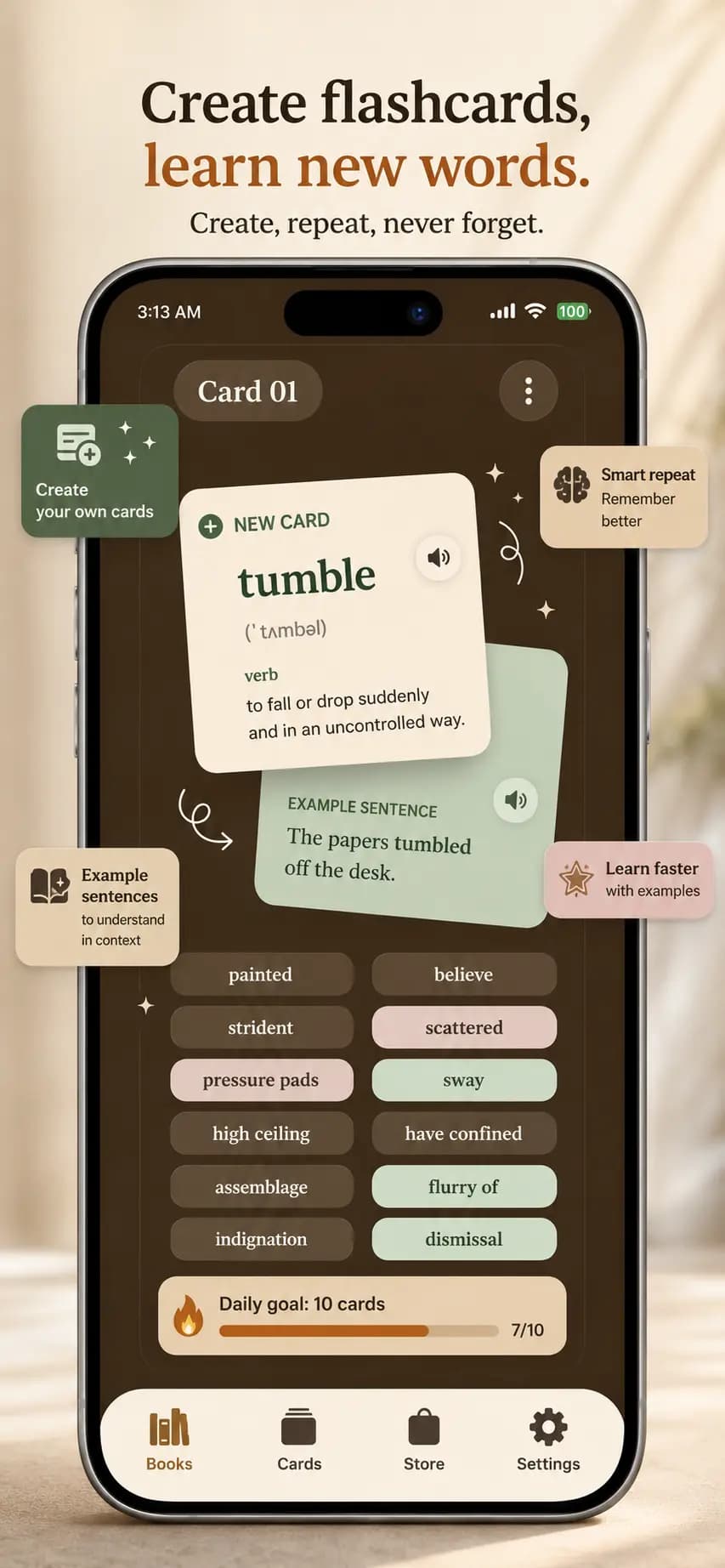
Okuzeka flashcards with an example sentence
Turn new words into flashcardsEvery word you save keeps its example sentence, so you review it in the context where you met it.
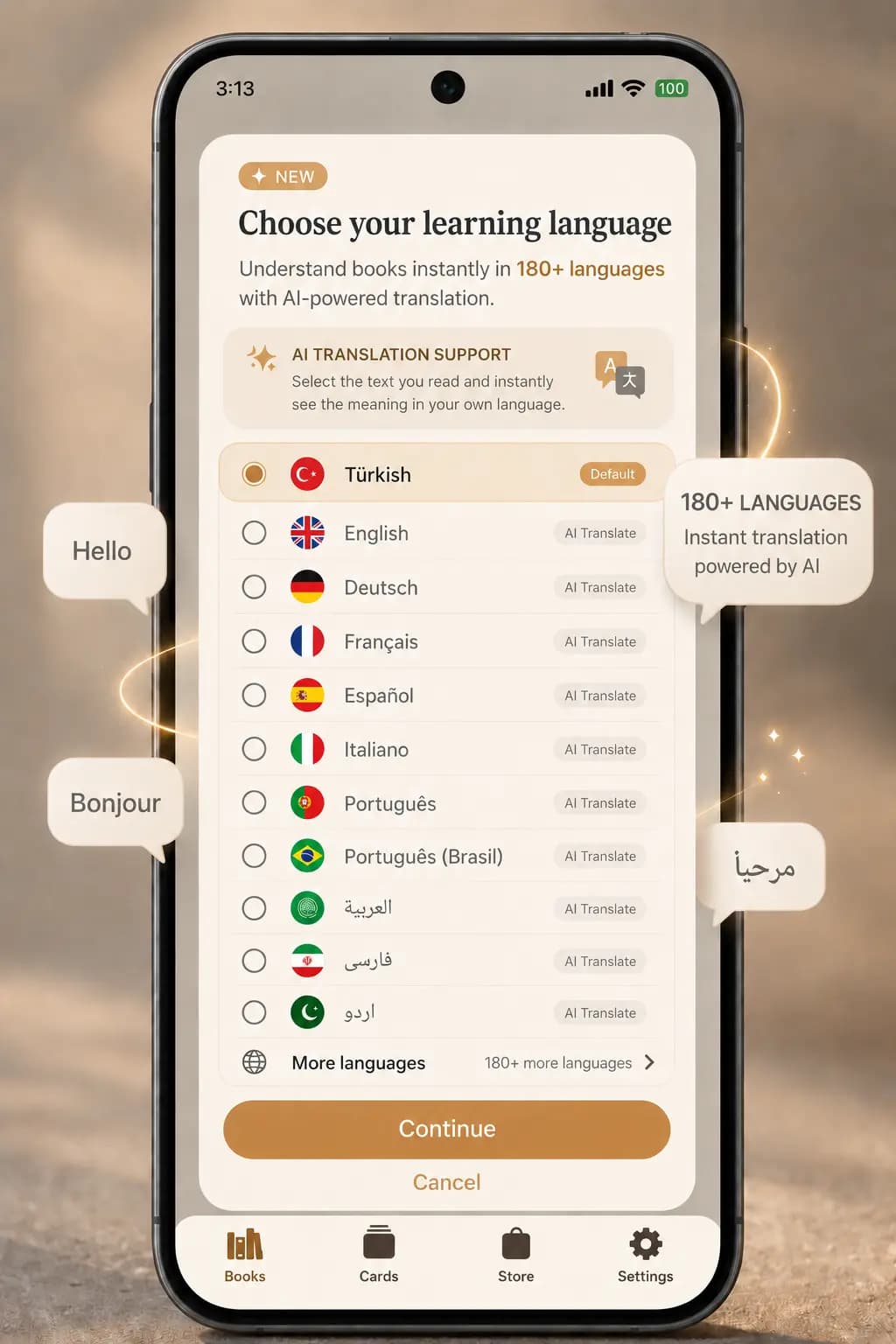
Choosing a translation language in Okuzeka
Explanations in 180+ languagesChoose your own language for meanings and translations, from Turkish and Spanish to Arabic and Japanese.
Adding your own PDF or EPUB books in Okuzeka
Free books or your own PDFsStart with free graded books from A1 to C2, or upload the PDF and EPUB files you already have.
FAQ

Frequently asked questions

How do I count word frequency in a text?

Paste the text above and press Analyze. The table lists every word with its count and percentage. Use the options to group by lemma, hide common words or ignore short words.

What is a good type-token ratio?

There is no single good value because TTR depends on text length. For texts of a few hundred words, values between 0.4 and 0.6 are common. Compare texts of similar length, or use the Guiraud index.

Can I download the results?

Yes. Press Download CSV to save the full frequency list with counts, percentages, frequency ranks and CEFR levels.

Which words are hidden as common words?

About 150 English function words: articles, pronouns, prepositions, auxiliary verbs and similar words such as "the", "of", "you" and "would".

Is the text uploaded?

No. Counting happens in your browser and your text is not sent anywhere.

Read at your level

Free English books from A1 to C2

Once you know your level, the next step is to read at it. Not sure of your level yet? Take the free English level test.

Sources and data
  • Word frequencies and ranks: wordfreq by Robyn Speer (CC BY-SA 4.0), lemmatized by Okuzeka.
  • CEFR levels: CEFR-J Wordlist 1.5 (Tono Laboratory, TUFS) and Octanove Vocabulary Profile C1/C2 (CC BY-SA 4.0).