Don Quixote book summary
In a village of La Mancha, a country gentleman reads so many books of chivalry that he loses his wits and decides to become a knight-errant. As Don Quixote of La Mancha he puts on old armour, mounts his bony horse Rocinante and rides out to right wrongs in honour of Dulcinea del Toboso, the farm girl he has chosen as his lady. The farm-labourer Sancho Panza, promised an island to govern, becomes his squire, and on their first adventure together the knight charges windmills he takes for giants. In the second part, now famous through the printed story of their deeds, they become the playthings of a duke and duchess, who make Sancho governor of the “island” of Barataria. Miguel de Cervantes’s two-part book of 1605 and 1615, often called the first modern novel, is a comic and moving study of illusion and reality, idealism and friendship.
Don Quixote at a glance
- Level
- C2
- Language
- English
- Pages
- 1,040
- Words
- about 422,984
- Unique words
- 16,553
- Estimated reading time
- 28–47 hours
- Formats
- EPUB and PDF
Reading time is an estimate at 150–250 words per minute.
Why this book is useful for C2 English learners
Don Quixote is useful for C2 English learners because it gives you demanding prose, layered meaning, unusual phrasing, and vocabulary that may feel literary, historical, or highly specific. As a classic text, it lets you meet vocabulary inside a real reading flow instead of memorizing isolated words.
Vocabulary difficulty
C2 vocabulary can include rare words, formal style, irony, allusion, and subtle shifts in register. Across about 1040 pages, Okuzeka helps you slow down only on the words or phrases that block understanding, so the difficulty becomes easier to manage without turning every paragraph into a translation exercise. This makes it a practical C2 vocabulary reading choice.
Recommended reading level
Best for strong readers who want challenging English texts with support only when meaning becomes unclear. If you are looking for C2 English books, this page gives you the book format, page count, category, and reading tools before you add it to your library.
Most common words in Don Quixote
Don Quixote contains about 422,984 words, 16,553 of them unique. These content words appear most often in the text:
- quixote×2116
- sancho×2096
- thou×1229
- good×846
- see×768
- thee×761
- know×714
- time×652
- great×647
- give×567
- master×558
- take×558
How to read Don Quixote with Okuzeka
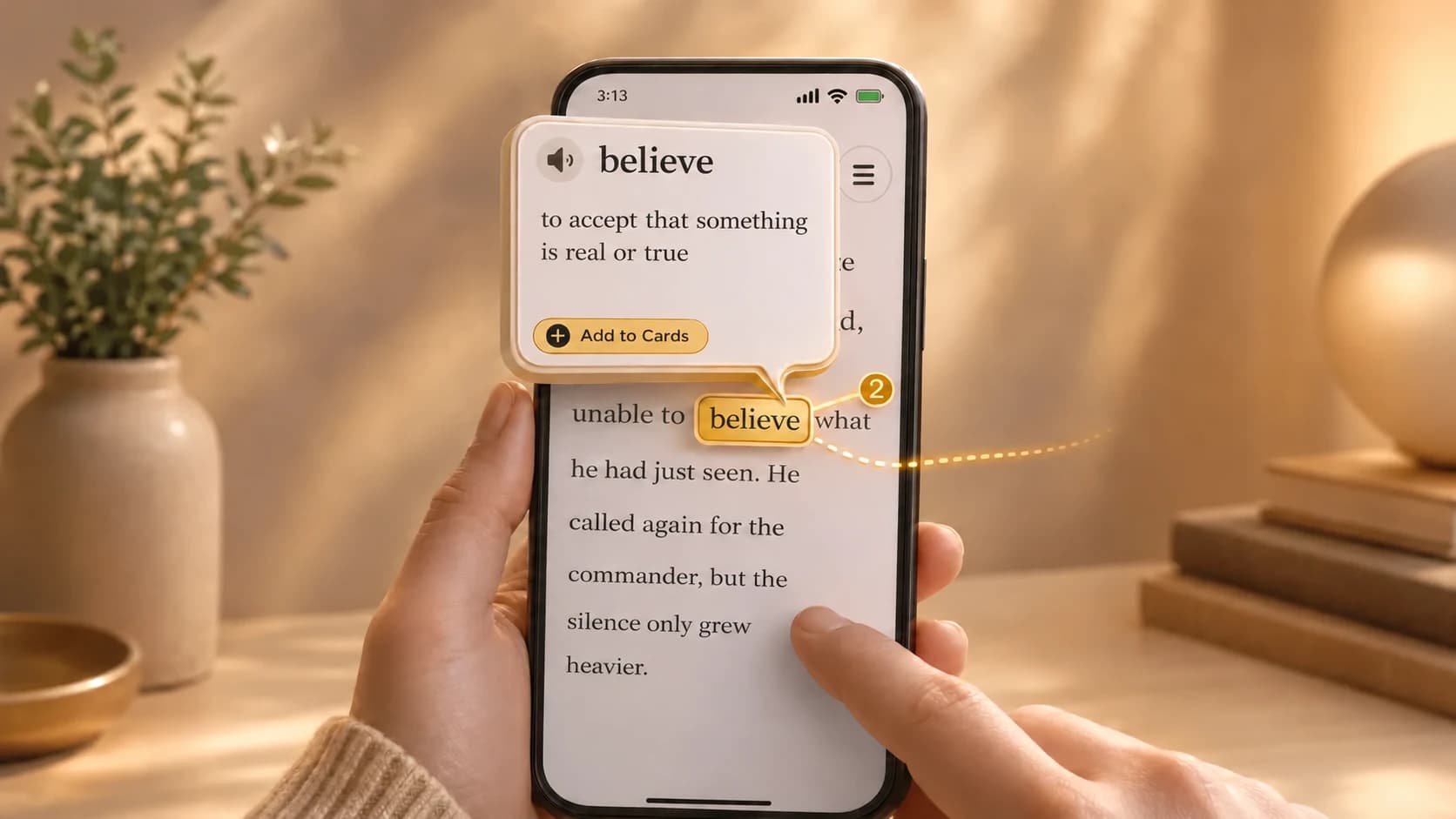
Add Don Quixote to your Okuzeka library, open it in the reader, and tap difficult words while you read. Okuzeka shows meanings in the sentence you are reading, lets you save useful vocabulary as flashcards, and keeps the book available across web, iOS, and Android.
- Add the book to your library.
- Read normally and tap only the words that stop you.
- Save useful words as flashcards for later review.
Similar C2 books
Don Quixote FAQ
Is Don Quixote good for C2 English reading practice?
Don Quixote can be used for C2 English reading because you can read the book in Okuzeka, check difficult words in context, and save vocabulary while staying inside the text.
Can I read Don Quixote as an EPUB in Okuzeka?
Yes. Don Quixote is available as an EPUB book in Okuzeka.
Which words appear most often in Don Quixote?
The most frequent content words in the text of Don Quixote are: quixote, sancho, thou, good, see, thee, know, time, great, give. The book contains about 422,984 words in total, 16,553 of them unique. While reading in Okuzeka you can tap any of these words to see the meaning they have in that sentence.
How long does it take to read Don Quixote?
Don Quixote has about 422,984 words. At a reading speed of 150 to 250 words per minute, that is roughly 28–47 hours of reading. This is an estimate: your own pace, and stopping to look up words, will change it.
Which formats is Don Quixote available in?
Don Quixote is available as EPUB and PDF. Reading it in the Okuzeka web reader, with tap-to-translate and flashcards, needs a free account.
How should I read Don Quixote with Okuzeka?
Read normally first, tap only the words or phrases that stop you, and save the useful ones as flashcards. This keeps EPUB and PDF reading close to real book reading instead of constant dictionary switching.