使い方
- 句動詞を検索するか、副詞・前置詞、型、頻度で絞り込みます。
- 意味と英文を読み、分離できる型かを確認します。
- 10問の空欄補充で適切な副詞・前置詞を選び、結果を復習します。
結果の見方と学習への活かし方
句動詞はgive upのように、動詞と副詞・前置詞がまとまって意味を表します。turn the light offのように分離できる型と、look after the kidsのように分離できない型があります。英文と英語の意味説明は練習教材としてそのまま残しています。
日常で使う130以上の句動詞を意味・例文付きで掲載。空欄補充テストで復習できます。
Please turn ___ the lightのような例文10問。意味をヒントに、up、off、outなどから選びます。
| 句動詞 | 意味 | 例文 | 種類 |
|---|---|---|---|
| calm down | become less angry or nervous | Calm down and tell me what happened. | 分離可能 |
| check in | register at a hotel or airport | We checked in at the hotel at three. | 目的語なし |
| come back | return | He came back from Spain last week. | 目的語なし |
| come in | enter | The door is open, so just come in. | 目的語なし |
| come on | used to encourage someone | Come on, we're going to be late! | 目的語なし |
| fill in | complete a form | Please fill in this form and sign it. | 分離可能 |
| find out | discover information | I need to find out what time the train leaves. | 分離可能 |
| get back | return | What time did you get back last night? | 目的語なし |
| get in | enter a car | Get in the car; it's starting to rain. | 分離不可 |
| get off | leave a bus, train or plane | Get off the bus at the second stop. | 分離不可 |
| get on | enter a bus, train or plane | We got on the train at the last minute. | 分離不可 |
| get out of | leave a car or place | She got out of the taxi and paid the driver. | 分離不可 |
| get up | get out of bed | I usually get up at seven. | 目的語なし |
| give back | return something | Can you give me back my book tomorrow? | 分離可能 |
| give up | stop doing or trying | He gave up smoking two years ago. | 分離可能 |
| go back | return to a place | I want to go back to Rome one day. | 目的語なし |
| go on | continue; happen | What's going on? Why is everyone shouting? | 目的語なし |
| go out | leave home to do something social | We went out for dinner on Friday. | 目的語なし |
| grow up | become an adult | She grew up in a small village by the sea. | 目的語なし |
| hurry up | do something more quickly | Hurry up, or we'll miss the bus! | 目的語なし |
| log in | enter a computer system | Log in with your email and password. | 目的語なし |
| log out | leave a computer system | Always log out on a shared computer. | 目的語なし |
| look after | take care of | My grandmother looks after the children on Mondays. | 分離不可 |
| look at | direct your eyes towards | Look at this photo from our holiday. | 分離不可 |
| look for | try to find | I'm looking for my keys. Have you seen them? | 分離不可 |
| look forward to | feel happy about something that will happen | I'm looking forward to seeing you next week. | 分離不可 |
| look out | be careful | Look out! There's a car coming. | 目的語なし |
| look up | search for information | Look the word up in a dictionary. | 分離可能 |
| pick up | collect someone or something | I'll pick you up from the station at six. | 分離可能 |
| put away | put something in its usual place | Put your toys away before dinner. | 分離可能 |
| put on | dress yourself in | Put your coat on; it's cold outside. | 分離可能 |
| sit down | take a seat | Please sit down and make yourself comfortable. | 目的語なし |
| slow down | become or make slower | Slow down! You're driving too fast. | 分離可能 |
| stand up | rise to your feet | Everyone stood up when the teacher came in. | 目的語なし |
| take care of | look after; deal with | Who will take care of your cat while you're away? | 分離不可 |
| take off | remove clothing | Please take off your shoes at the door. | 分離可能 |
| throw away | put in the rubbish | Don't throw away those boxes; we can use them. | 分離可能 |
| try on | put on clothes to see if they fit | Can I try these jeans on? | 分離可能 |
| turn down | decrease the volume or heat | Could you turn the radio down a bit? | 分離可能 |
| turn off | stop a machine or light | Turn the TV off before you go to bed. | 分離可能 |
| turn on | start a machine or light | Can you turn on the light? It's dark in here. | 分離可能 |
| turn up | increase the volume or heat | Turn the music up; I love this song. | 分離可能 |
| wake up | stop sleeping | She woke up when the phone rang. | 目的語なし |
| write down | write on paper to remember | Write down my number before you forget it. | 分離可能 |
| break down | stop working (a machine) | Our car broke down on the motorway. | 目的語なし |
| break up | end a relationship | They broke up after five years together. | 目的語なし |
| bring up | raise a child | She was brought up by her aunt. | 分離可能 |
| bring up | mention a subject | Don't bring up politics at dinner. | 分離可能 |
| call back | return a phone call | I'm busy now; can I call you back later? | 分離可能 |
| call off | cancel | They called off the match because of the rain. | 分離可能 |
| carry on | continue | Carry on with your work; I'll be back soon. | 目的語なし |
| catch up | reach the same level as others | I missed a week of school and need to catch up. | 目的語なし |
| check out | leave a hotel after paying | You have to check out before eleven. | 目的語なし |
| cheer up | become or make happier | Cheer up! It's not the end of the world. | 分離可能 |
| come across | find by chance | I came across an old letter in the attic. | 分離不可 |
| come up with | think of an idea or plan | She came up with a brilliant solution. | 分離不可 |
| count on | rely on | You can always count on me. | 分離不可 |
| cut down on | reduce the amount of | I'm trying to cut down on sugar. | 分離不可 |
| deal with | handle a problem or task | The manager will deal with your complaint. | 分離不可 |
| drop off | take someone somewhere and leave them | Can you drop me off at the station? | 分離可能 |
| end up | finally be in a situation | We got lost and ended up in the wrong town. | 目的語なし |
| figure out | understand or solve | I can't figure out how this machine works. | 分離可能 |
| get along | have a good relationship | Do you get along with your neighbours? | 目的語なし |
| get over | recover from | It took her months to get over the illness. | 分離不可 |
| get rid of | throw away; remove | We need to get rid of these old chairs. | 分離不可 |
| give in | finally agree after refusing | The children kept asking until their dad gave in. | 目的語なし |
| go ahead | start or continue; permission | "Can I ask a question?" "Sure, go ahead." | 目的語なし |
| go off | explode; ring (an alarm) | My alarm went off at six. | 目的語なし |
| go over | check or review | Let's go over the plan one more time. | 分離不可 |
| go through | experience something difficult | She went through a difficult time after the accident. | 分離不可 |
| hand in | give work to a teacher | Hand in your essays by Friday. | 分離可能 |
| hang out | spend time relaxing with people | We usually hang out at the park after school. | 目的語なし |
| hang up | end a phone call | He got angry and hung up on me. | 目的語なし |
| hold on | wait a short time | Hold on, I'll get a pen. | 目的語なし |
| keep on | continue doing | He kept on talking during the film. | 分離不可 |
| keep up with | move or progress at the same speed | It's hard to keep up with all the new technology. | 分離不可 |
| leave out | not include | You left out an important detail. | 分離可能 |
| let down | disappoint | I promised to help, and I won't let you down. | 分離可能 |
| look into | investigate | The police are looking into the robbery. | 分離不可 |
| make up | invent a story or excuse | He made up an excuse for being late. | 分離可能 |
| make up | become friends again after an argument | They argued, but they made up the next day. | 目的語なし |
| mix up | confuse two things | I always mix up their names. | 分離可能 |
| move in | start living in a new home | Our new neighbours moved in last week. | 目的語なし |
| move out | leave your home to live elsewhere | She moved out of her parents' house at twenty. | 目的語なし |
| pass away | die (polite) | His grandfather passed away last year. | 目的語なし |
| pay back | return money you borrowed | I'll pay you back on Friday. | 分離可能 |
| point out | draw attention to | She pointed out a mistake in my report. | 分離可能 |
| put off | delay, postpone | Don't put off your homework until Sunday night. | 分離可能 |
| put up with | tolerate | I can't put up with this noise any longer. | 分離不可 |
| run away | escape, leave suddenly | The dog ran away when it heard the thunder. | 目的語なし |
| run into | meet by chance | I ran into an old friend at the supermarket. | 分離不可 |
| run out of | have no more of something | We've run out of milk. | 分離不可 |
| set off | start a journey | We set off early to avoid the traffic. | 目的語なし |
| set up | start a business or organisation | They set up their own company in 2015. | 分離可能 |
| show off | try to impress people | He's always showing off his new car. | 目的語なし |
| show up | arrive, appear | Only five people showed up to the meeting. | 目的語なし |
| sort out | solve or organise | Don't worry, we'll sort it out. | 分離可能 |
| stand for | be an abbreviation of; represent | "UN" stands for United Nations. | 分離不可 |
| take after | look or behave like an older relative | She takes after her mother. | 分離不可 |
| take back | return something to a shop; withdraw words | I'm sorry; I take back what I said. | 分離可能 |
| take off | leave the ground (a plane) | The plane took off an hour late. | 目的語なし |
| take up | start a new hobby | I took up yoga last spring. | 分離可能 |
| tell off | speak angrily to someone who did wrong | The teacher told us off for talking. | 分離可能 |
| think over | consider carefully | Think it over and give me your answer tomorrow. | 分離可能 |
| turn down | refuse an offer | She turned down the job because the pay was too low. | 分離可能 |
| turn into | change into something different | The caterpillar turned into a butterfly. | 分離不可 |
| turn out | end in a particular way; prove to be | It turned out that he was right all along. | 目的語なし |
| watch out | be careful | Watch out for ice on the road. | 目的語なし |
| work out | exercise | I work out at the gym three times a week. | 目的語なし |
| work out | calculate or understand | Can you work out how much we owe? | 分離可能 |
| blow up | explode; destroy with explosives | The old bridge was blown up during the war. | 分離可能 |
| bring about | cause to happen | The internet brought about huge changes. | 分離可能 |
| carry out | do a task or plan | The scientists carried out several experiments. | 分離可能 |
| drop out | leave a course or competition early | He dropped out of university after one year. | 目的語なし |
| fall out | stop being friends after an argument | They fell out over money. | 目的語なし |
| fit in | feel accepted in a group | It took me a while to fit in at my new school. | 目的語なし |
| get across | communicate an idea clearly | He found it hard to get his ideas across. | 分離可能 |
| get away with | avoid punishment for | He cheated in the exam and got away with it. | 分離不可 |
| hold up | delay | Sorry I'm late; I was held up in traffic. | 分離可能 |
| kick off | start (a match or event) | The match kicks off at eight. | 目的語なし |
| lay off | end someone's job because there is no work | The factory laid off two hundred workers. | 分離可能 |
| look down on | think you are better than | Don't look down on people with less money. | 分離不可 |
| look up to | admire and respect | She has always looked up to her older sister. | 分離不可 |
| make out | see or hear with difficulty | I could just make out a figure in the fog. | 分離可能 |
| pass out | faint | It was so hot that a man passed out. | 目的語なし |
| rule out | decide something is not possible | The doctor ruled out a serious illness. | 分離可能 |
| see off | go to the station or airport to say goodbye | We went to the airport to see her off. | 分離可能 |
| stand out | be easy to notice | Her red coat stood out in the crowd. | 目的語なし |
| take in | understand and remember | There was too much information to take in. | 分離可能 |
| take over | take control of | A bigger company took over the business. | 分離可能 |
| wear out | make very tired; use until damaged | The long walk wore me out. | 分離可能 |
句動詞はgive upのように、動詞と副詞・前置詞がまとまって意味を表します。turn the light offのように分離できる型と、look after the kidsのように分離できない型があります。英文と英語の意味説明は練習教材としてそのまま残しています。
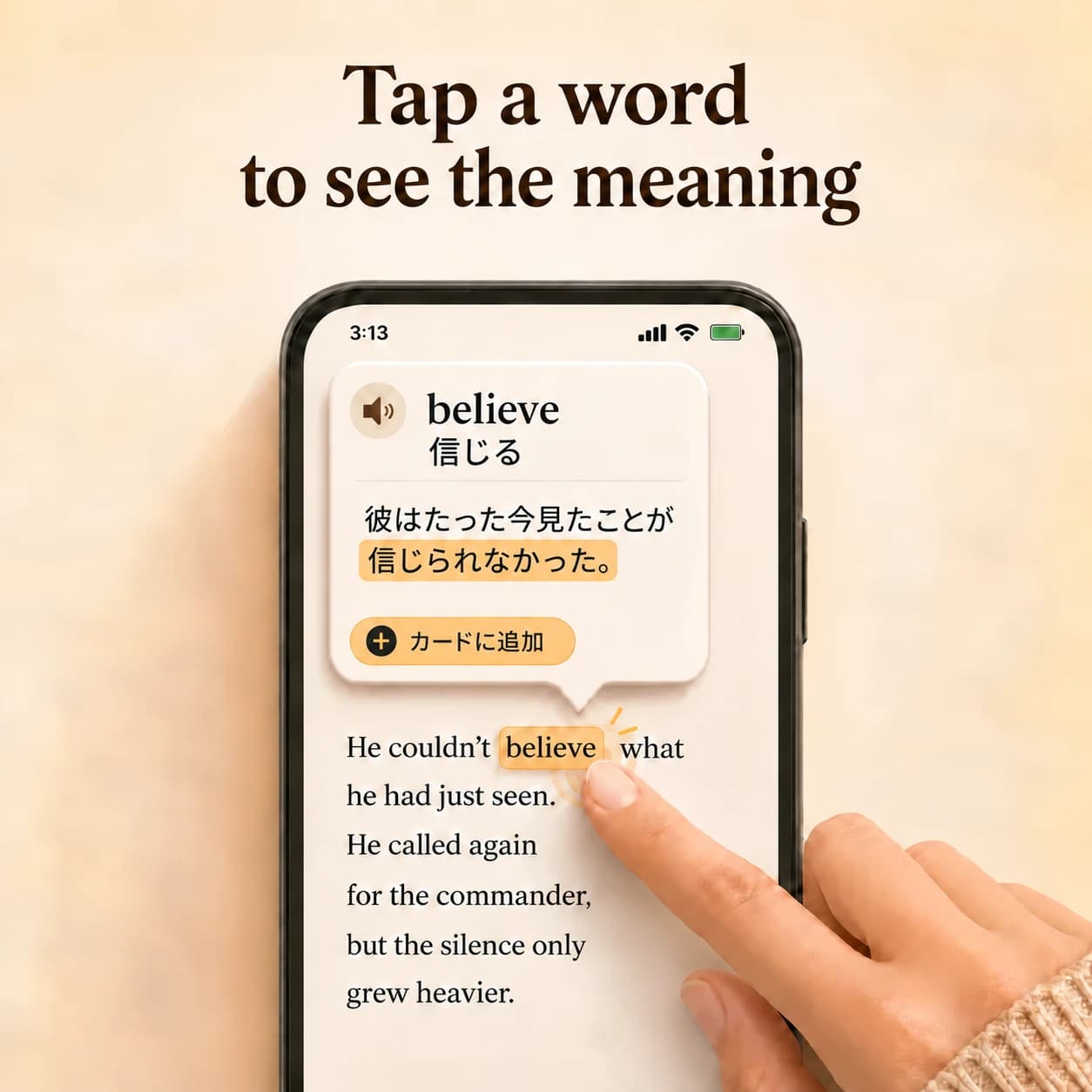
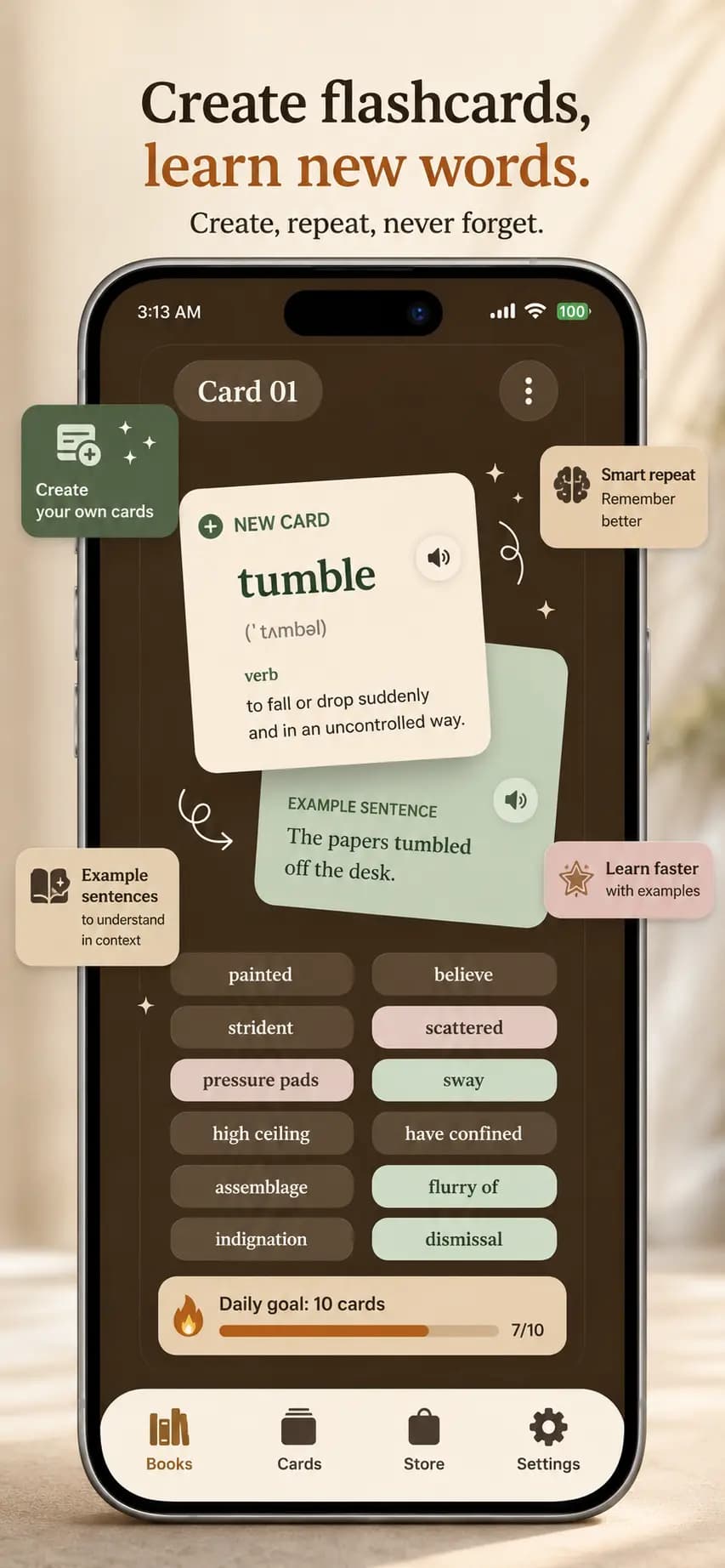
このツールで現在地を確認したら、Okuzekaで次のステップへ。自分のレベルの本を読み、知らない単語をその場で理解してカードで復習できます。

文脈によって複数の意味があります。このリストでは表示された意味と例文をセットで学びましょう。
分離可能な型では通常、turn it offのように間に置きます。例文ごと覚えると使いやすくなります。