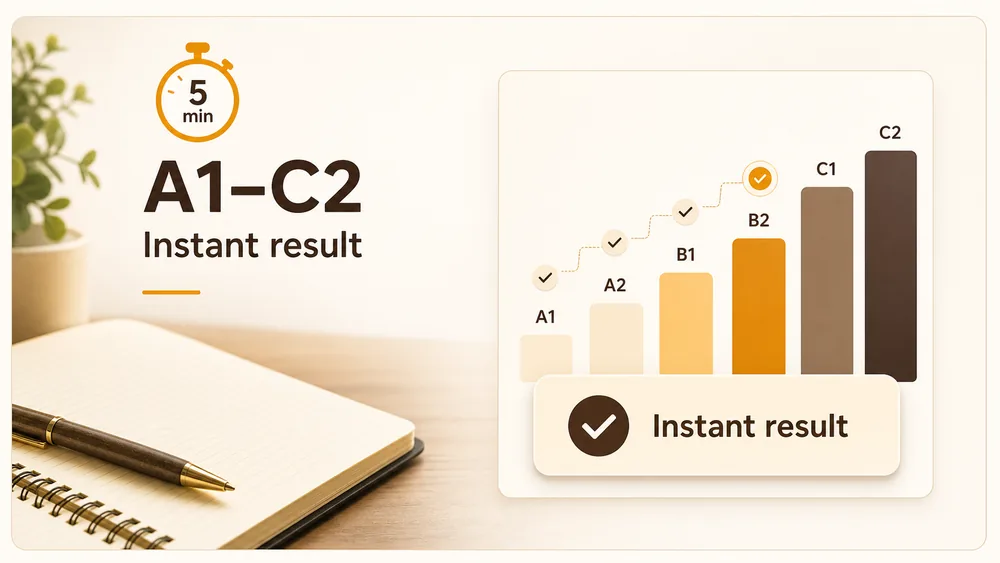
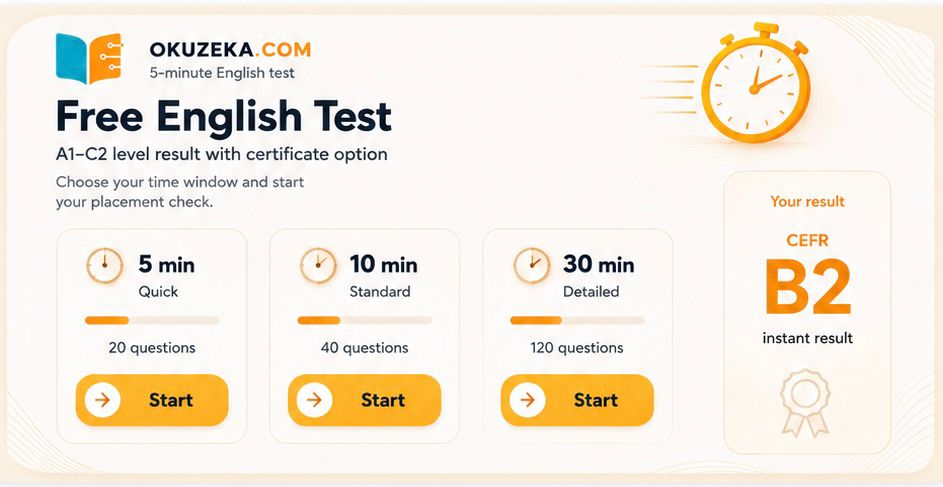
Need a fast, free English level test with no sign up? This 5-minute English level test gives you a quick A1-C2 placement estimate using 20 grammar and vocabulary questions. No account, no password drama, no email treasure hunt.
5 minShort level test
20Mixed-level questions
A1-C2Instant CEFR estimate
What does the quick English level test measure?
The questions sample everyday vocabulary, sentence structure, verb forms, articles, prepositions, conditionals and more advanced language choices. Easier and harder items are mixed to identify a broad level range, because your English level should not be guessed from vibes alone.
Who should choose the 5-minute English level test?
This version is ideal when you are short on time, comparing course materials, checking your level before starting a study plan or taking an initial placement test on a phone. Answer without a translator or dictionary so the English level test reflects your independent knowledge, brave little keyboard and all.
Set aside five uninterrupted minutes. Read every sentence, choose the best answer, and keep moving if one question looks at you funny. You can review the English level test score, correct answers, mistakes and empty responses when the test ends.
No sign up. No email quest. Your English level test result appears immediately.
Recommended English level test
10-Minute Free Online English Level Test
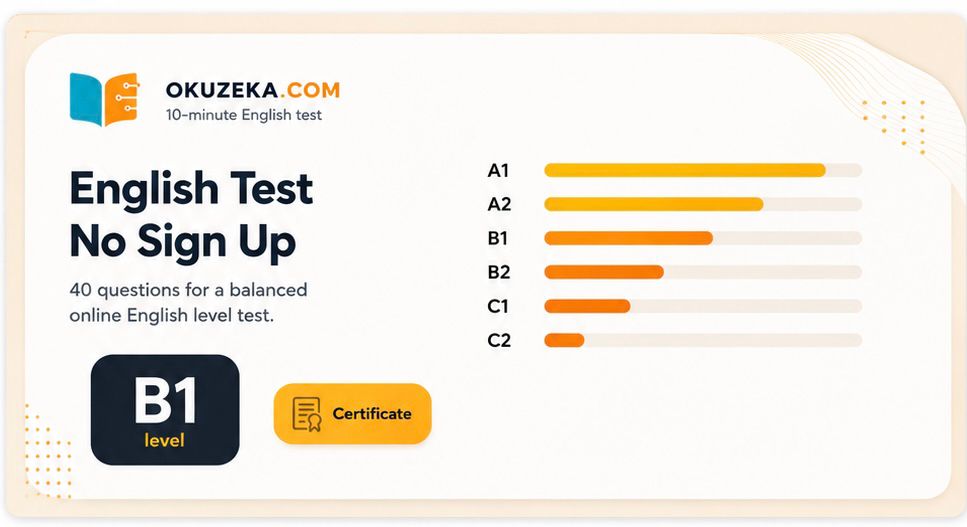
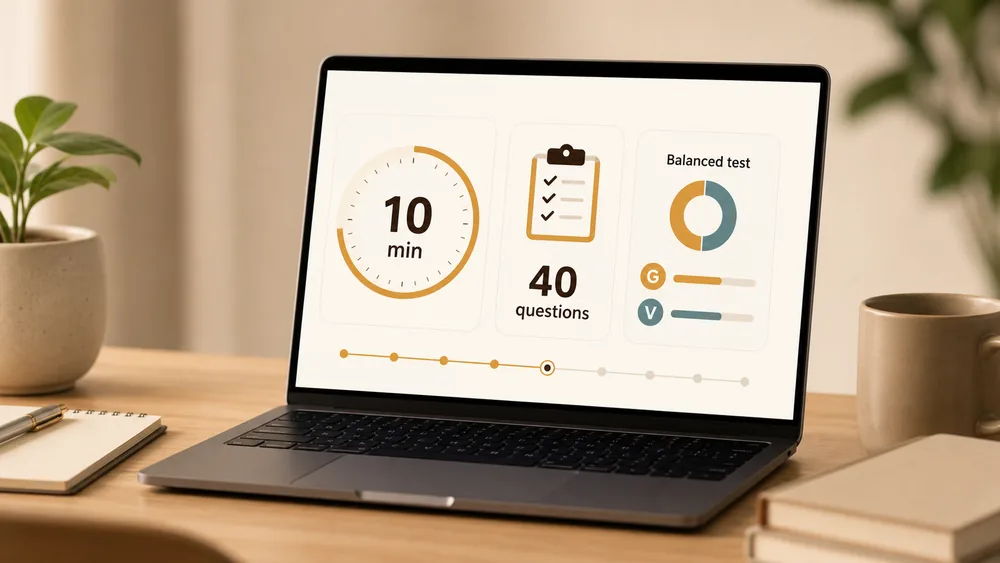
The 10-minute free English level test is the recommended choice for most learners who want an English level test with no sign up. It uses 40 questions for a balanced A1, A2, B1, B2, C1 or C2 estimate, with enough coverage to be useful and short enough to avoid becoming a personality test.
10 minBalanced level test
40Grammar and vocabulary items
OnlineCertificate option included
Why choose the standard English level test?
Forty questions allow the English level test to check a wider collection of language patterns. An individual mistake or lucky guess has less influence than it does in the 5-minute version. This makes the standard level test useful when choosing a course level, planning lessons with a teacher or measuring your approximate English placement before beginning new learning materials.
How should you take the 10-minute English level test?
Find a quiet place, close translation tools and answer independently. The English level test includes basic and advanced questions, so it is normal to meet items you do not know. Make your best choice and continue. A placement test is supposed to find the point where questions become challenging.
This online English level test focuses on grammar and vocabulary. Speaking, listening, pronunciation and extended writing require additional assessment. Use the result as a practical guide, not as a crown, trophy or legal document.
Free 40-question English level test, instant placement result and an optional Okuzeka certificate.
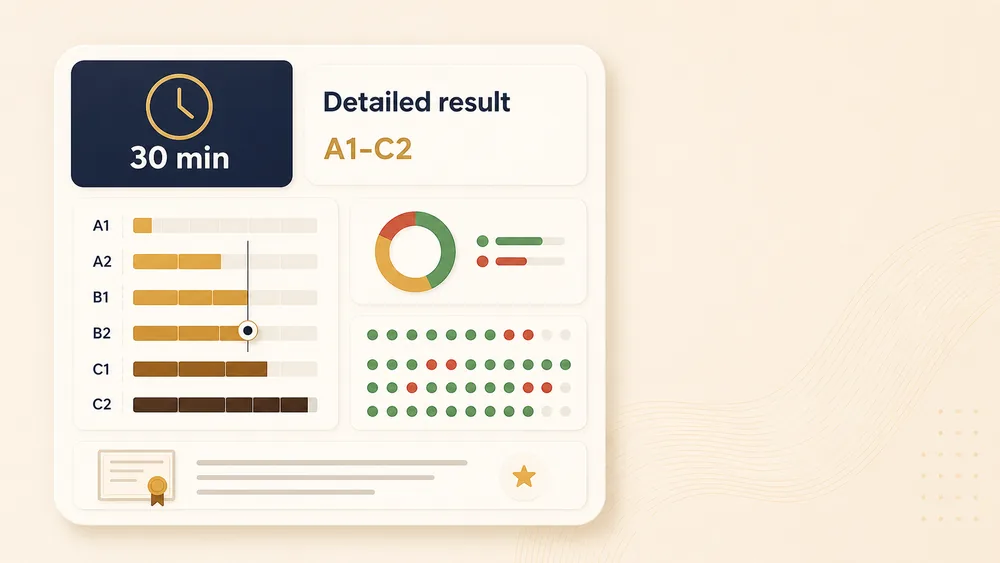
Detailed English level test
30-Minute Free Detailed English Level Test
Choose the 30-minute free English level test when you want the most detailed assessment on this page. Its 120 questions explore grammar and vocabulary from beginner foundations to advanced choices, basically the long walk, but with a useful English level test result at the end.
30 minFocused assessment
120Largest question sample
A1-C2Detailed placement range
What makes the detailed English level test different?
The assessment has enough questions to check consistency across many language topics. It is useful for learners returning to English after a break, students comparing B2 and C1 performance, advanced users seeking a challenge or teachers who need a substantial first placement indicator. A few mistakes have less influence on a 120-question result than on a short test.
How to get the clearest English level test result
Reserve the full half hour and complete the English level test without interruptions. Work steadily rather than rushing. Read the context, eliminate clearly unsuitable answers and make your best decision when uncertain. Do not consult external tools. Let the test meet your real English, not your browser tabs.
A detailed online English level test still cannot replace a supervised four-skill examination. For university, employment or immigration evidence, check which official tests the relevant organization accepts.
Complete 120 questions for the broadest grammar and vocabulary English level test estimate.
5-minute guide
5-Minute Free English Level Test No Sign Up: Quick A1-C2 Level Check
The 5-minute free English level test is made for learners who want a fast, practical answer before choosing a course, lesson, textbook or study plan. It is short enough to complete during a break, but it still samples the CEFR range from A1, A2, B1 and B2 to C1 and C2. Because there is no sign up, no account form and no waiting screen, the experience stays focused on the actual level test.
Free English level testEnglish level test no sign upA1-C2 level testCertificate option
5-minute free English level test · no sign up
Why choose the 5-minute English level test?
A short test is useful when you do not yet know where to begin. Many learners waste time with material that is too easy or too advanced because they guess their level from memory, school history or confidence. The 5-minute free English level test gives a quick placement signal based on real answers instead of a feeling. It is not designed to replace a full exam, but it is very helpful when you need a first direction. If you are looking for an English level test no sign up, this quick version removes the biggest friction: you open the page, choose the five-minute window and begin.
The test uses 20 questions, so it works best as a snapshot. A snapshot is still valuable. It can tell a beginner that A1 or A2 material is more suitable, show an intermediate learner whether B1 or B2 content may be a better fit, or give an advanced learner a reason to try the longer version. Because the result appears immediately, the five-minute test is a good first step before a class, trial lesson, self-study plan, school placement conversation or personal learning reset.
Quick level check
See your likely English level before choosing a study path
The 5-minute test is built for a fast first direction. It helps you decide whether beginner, intermediate or advanced material is the better next step before you spend time on a course or lesson.
You still get the same simple Okuzeka experience: no sign up, clear questions, instant result and an optional certificate after completion.
Speed is the main advantage. You do not need to prepare a document, enter an email address or create a password. You can take the free English level test on a phone, tablet or desktop browser. The short format also reduces pressure for nervous learners. Some people avoid level tests because they imagine a long exam with complicated instructions. This version keeps the process simple: read the sentence, choose the best answer and continue until the timer or the question list is complete.
What the 20 questions can show
The 5-minute test samples grammar and vocabulary across multiple CEFR levels. At lower levels, questions may check everyday words, basic verb forms, simple present patterns, articles, pronouns and common prepositions. At intermediate levels, the test may include past forms, present perfect meaning, modals, conditionals, relative clauses, passive voice and common word-choice differences. At advanced levels, questions may test precision, collocation, register, clause structure and meaning that depends on context.
Because the test is short, each answer has a clear impact on the score. That is normal. A quick free English level test should be interpreted as a direction, not as a final verdict about your entire language ability. If you miss one easy item because you read too quickly, the score can move. If you guess one hard item correctly, the score can also move. The best use of the result is to identify a likely range and then decide whether you need a broader check with the 10-minute or 30-minute option.
A1-C2 estimate
A short test can still give useful placement guidance
Twenty questions cannot replace a full official exam, but they can show a practical direction. The result helps you decide whether to continue with the quick estimate or open the 10-minute or 30-minute test for more detail.
This keeps the page useful for learners who want a free English level test no sign up and do not want a long assessment first.
The test cannot fully measure speaking, listening, pronunciation, fluency or writing. A learner may know grammar well but feel nervous speaking. Another learner may speak confidently but make frequent grammar errors in writing. This is why the result is called an estimated English level. It is a practical CEFR placement indicator that helps you choose learning material, but it should be combined with speaking, listening and writing practice when important decisions depend on your English ability.
Best use: choose the 5-minute free English level test when you need a fast level check, a simple starting point or a low-pressure English level test no sign up before trying a longer assessment.
How to take the quick test well
Set aside five quiet minutes. Close translation tools, grammar checkers and search tabs. The purpose is not to get the highest possible score; the purpose is to learn where your independent knowledge currently sits. If you use outside help, the result may place you above your real working level, and then your study material may become frustrating. A placement test is most useful when it is honest.
Read the whole sentence before choosing an answer. In English grammar questions, one option may look correct when you only read the first few words, but the end of the sentence can change the meaning. Notice time expressions such as yesterday, already, since, for, usually, currently, unless and although. These small words often signal the correct tense, structure or connector. If a question feels difficult, make your best choice and move forward.
Do not panic if some questions look too easy or too difficult. A good A1-C2 level test needs a wide range. Beginner questions help confirm the foundation, while advanced questions show where the boundary is. You are not expected to know everything. The point is to find the place where your answers begin to become less consistent.
How to understand the result
An A1 result suggests that beginner material is the safest starting point. Focus on common phrases, basic sentence building and high-frequency vocabulary. An A2 result means you can handle many everyday patterns but should still strengthen past forms, questions, simple descriptions and routine communication. A B1 result shows developing independence: you can understand main points and express familiar ideas, but you need more range and accuracy.
A B2 result suggests upper-intermediate control. You can probably work with longer texts, natural videos, conversation practice and structured writing. A C1 result shows advanced grammar and vocabulary performance in this question set. You should focus on precision, style, collocation and complex tasks. A C2 estimate means you answered the current grammar and vocabulary sample extremely strongly, although a full C2 judgement would require demanding speaking, listening, reading and writing tasks.
If your score is close to a boundary, treat the result carefully. Language level is not a perfect staircase. You may be B1 in grammar, B2 in reading and A2 in speaking confidence. Use the five-minute result as a quick map, then check your real-life skills through practice.
Why “no sign up” matters for learners
Many users search for a free English level test no sign up because they want to check their level without giving personal information before they know whether the tool is useful. That is a reasonable expectation. A simple placement test should let the learner focus on the questions first. On this page, you can start the assessment without an account. Your name is requested only later if you decide to create the optional Okuzeka certificate.
This approach also helps teachers and course advisers. A teacher can ask a learner to open the quick test, complete it independently and share the estimated level. The short format works well at the beginning of a lesson, in a consultation or before recommending homework. It is not an official exam, but it can support a better conversation about what the learner needs next.
Certificate after the quick test
After the result, you can create an Okuzeka certificate that records the estimated level, score and completion date. The certificate is written in English and is useful as a personal learning record, an informal portfolio item or a motivation marker. It should not be described as an accredited language qualification. For university admission, employment evidence or immigration requirements, always check which official examination is accepted by the relevant institution.
The certificate is most meaningful when you use it with a study plan. Write down the result, choose materials near your level and return after several weeks of consistent practice. If your 5-minute result feels too high or too low, take the 10-minute test for a broader sample. If you need the strongest placement estimate available on this page, take the 30-minute version when you have enough time.
Quick test FAQ
Is the 5-minute test enough?
It is enough for a quick starting point. It is not enough for a complete evaluation of every English skill. Use it when speed matters, and use the longer tests when detail matters.
Can beginners use it?
Yes. The question bank covers A1 and A2 foundations as well as higher levels. Beginners may meet difficult questions, but that is part of finding the correct placement range.
Can advanced learners use it?
Yes. Advanced learners can use it as a fast check, but the 30-minute test is better when distinguishing B2, C1 and C2 performance is important.
Should I retake it immediately?
Usually no. Retaking immediately may measure memory of the questions. Study first, practise regularly and retake later to compare progress more fairly.
Final tips for a useful five-minute result
Before you press start, decide that you will accept the result as information, not as a judgement. A free English level test is most helpful when it points you toward the next sensible action. If the result is lower than expected, it may simply mean that some basic structures need review. That is good news because clear foundations make later progress faster. If the result is higher than expected, choose slightly more challenging material and check whether you can understand it without constant translation.
Use the five-minute result with one small study action on the same day. For example, an A1 or A2 learner can learn ten useful phrases and write five simple sentences. A B1 learner can read a short article and summarize it. A B2 learner can listen to a short podcast and note natural phrases. A C1 or C2 learner can rewrite a paragraph in a more formal or precise style. When the test result turns into action immediately, the level check becomes part of real learning instead of a number that is quickly forgotten.
The best long-term plan is simple: test, study, use English, review mistakes and test again later. Do not depend on one score alone. Notice whether reading feels easier, whether listening requires fewer pauses, whether speaking becomes less stressful and whether writing becomes clearer. The five-minute free English level test no sign up is the fastest doorway into that cycle, and the longer Okuzeka tests are available when you want more evidence.
If you share the result with a teacher, tell them which questions felt easy, which felt uncertain and whether the timer changed your performance. That short reflection gives more context than a score alone and helps the teacher recommend a better starting lesson.
How to get the best value from a five-minute placement check
Use the five-minute option as a clear first signal, not as a final judgment about your whole English ability. A quick free English level test is most useful when you need to decide what to do next today: which lesson to open, which book level to choose, which video series to follow, or whether you should move from beginner review to intermediate practice. Because the test is short, it works best when you answer naturally and avoid pausing to search online. If a question looks unfamiliar, choose the most reasonable answer and continue. That keeps the result closer to your real working knowledge.
After the result appears, compare the level with your everyday experience. If the test places you around A1 or A2, ask whether you can understand simple instructions, introduce yourself, describe daily routines and recognize common words without heavy translation. If the result is B1 or B2, think about whether you can follow the main idea in articles, short videos and conversations. If the estimate is C1 or C2, look for evidence of precision: advanced vocabulary, natural grammar choices, and the ability to understand implied meaning. This reflection makes the online English level test more useful than a number alone.
The five-minute window is also helpful for repeated progress checks, as long as you do not repeat it too often. Retaking any English test immediately can measure memory of questions instead of learning. A better rhythm is to study for several weeks, use new reading or vocabulary practice, then return for another quick check. If your result moves upward and real tasks feel easier too, you have stronger evidence of progress. If the result stays the same, that is still useful: it tells you to adjust your plan, review the weak areas and choose more suitable material.
If you want a level test with certificate after the quick version, create it as a personal record of completion. The certificate is useful for motivation, informal portfolios and sharing a learning milestone with a teacher, but it should not replace an official supervised exam. For course placement or self-study planning, however, this free English level test no sign up format gives a fast and practical starting point across A1, A2, B1, B2, C1 and C2.
10-minute guide
10-Minute Free Online English Level Test with No Sign Up
The 10-minute free online English level test is the best balanced choice for most learners. It gives more coverage than the quick version, but it stays short enough to finish in one focused sitting. With 40 grammar and vocabulary questions, the test provides a stronger A1-C2 placement estimate while keeping the experience simple, clear and no sign up.
Online English level testFree English level testNo sign upLevel test with certificate
10-minute online English level test
Why the 10-minute test is the recommended option
The 10-minute English test is recommended because it balances convenience and reliability. A very short test is fast, but a single mistake can change the result noticeably. A very long test gives more evidence, but not every learner has the time or concentration for a detailed assessment. The 10-minute version sits between those needs. It includes 40 questions, which allows the system to sample more grammar points, more vocabulary bands and more difficulty levels than the five-minute version.
For many learners, 10 minutes is enough to produce a useful placement result without turning the experience into a stressful exam. You can complete it before joining a course, after finishing a unit, while comparing language schools, or when planning a new self-study routine. Because it is a free English level test with no sign up, you can use it as a practical first step instead of a formal application process. The page opens, the instructions are simple and the result appears immediately after completion.
Balanced 10-minute test
A standard English test when you want more than a quick snapshot
The 10-minute option gives the test more room to check grammar and vocabulary across different levels. It is still fast, but it feels more balanced than a very short placement check.
This makes it useful before choosing a class, planning a study routine or comparing nearby CEFR levels such as A2/B1 or B1/B2.
The 40-question format also reduces the effect of random guessing. Every multiple-choice test includes some chance, but a larger sample makes the final estimate more stable. If one question is misread, another question may still show the same skill. If one vocabulary item is unfamiliar, other items can show whether the issue is a single word or a broader level gap. This is why the 10-minute test is especially useful for choosing between nearby levels such as A2 and B1, B1 and B2, or B2 and C1.
What the standard level test measures
The test focuses on grammar and vocabulary because these areas can be checked quickly and consistently in an online multiple-choice format. Grammar questions may include verb tense, word order, conditionals, modal verbs, articles, prepositions, passive structures, relative clauses, reported speech, clauses of contrast and cause, and other patterns that learners meet as they progress. Vocabulary questions may check everyday meaning, academic or professional word choice, common collocations, phrasal verbs, nuance and register.
A1 and A2 questions confirm the learner’s foundation. They show whether basic sentence patterns, common verbs, simple questions and everyday words are already secure. B1 and B2 questions explore more independence: the ability to understand longer sentences, choose accurate structures and handle meaning across a wider context. C1 and C2 questions look for precision, flexibility and advanced control. A test that includes all these bands can provide an A1-C2 placement estimate rather than only a beginner or intermediate score.
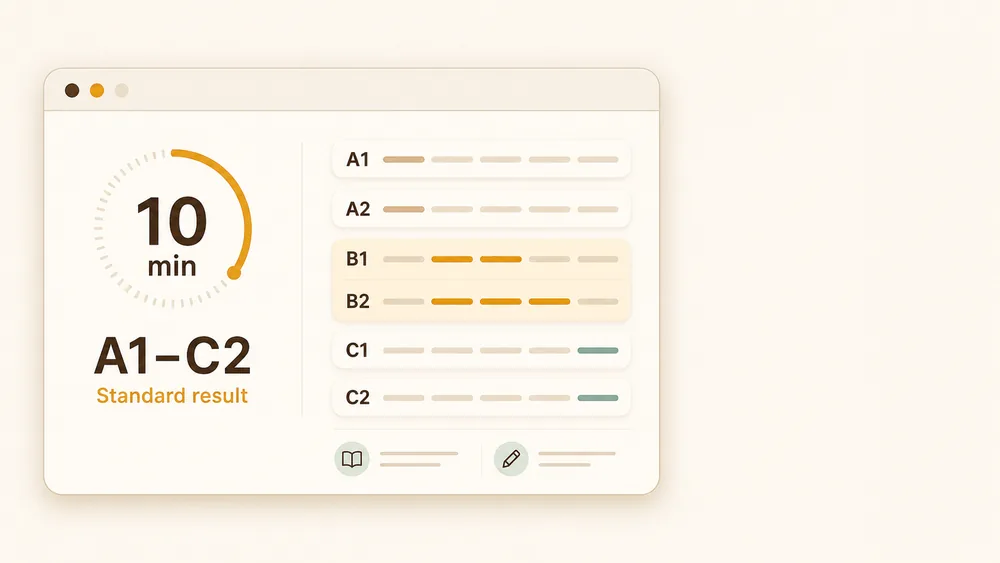
Standard result
Forty questions help reduce random guessing
A larger question sample makes the result steadier. One lucky answer or one careless mistake has less influence than it does in a five-minute test.
Use the result as a practical guide, then open the answer review to see which grammar and vocabulary choices affected your level estimate.
The result is still an estimate. A complete English evaluation should include listening, speaking, reading and writing. A learner may understand grammar rules but struggle to use them in conversation. Another learner may speak fluently but choose inaccurate written forms. The 10-minute online English level test is best understood as a practical grammar and vocabulary placement guide. It helps you choose the right learning path, but it does not replace a supervised four-skill examination when official evidence is required.
Best use: choose the 10-minute free English level test when you want a stronger placement estimate than a quick check, but you still want a simple online English level test no sign up.
Before you begin
Prepare your environment before clicking start. Ten minutes is short, but it is long enough that distractions can affect the result. Put your phone on silent if you are using a computer, or close notifications if you are using a phone. Avoid translators, grammar tools and online dictionaries. The goal is not to impress the page; the goal is to learn which English level will help you study efficiently.
Read every question as a complete sentence. In many English questions, tense, article choice or preposition choice depends on the full context. Do not choose the first option that sounds familiar. Compare all options and ask which one fits both grammar and meaning. If two options seem possible, look for small clues such as time expressions, subject-verb agreement, countable or uncountable nouns, and whether the sentence is formal or informal.
Work at a steady pace. You do not need to spend the same amount of time on every item. Easy questions should be answered quickly. Difficult questions should receive enough attention, but not so much that the timer becomes a problem. If you are unsure, make your best choice and continue. Leaving too many empty answers can make the result less useful.
After the result appears
Start with the estimated CEFR level, then look at the score and answer review. Correct answers show what you demonstrated in this question set. Wrong answers may reveal topics to review. Empty answers may show time pressure, uncertainty or unfamiliar structures. The combination is more useful than the level label alone.
If you receive A1 or A2, build a strong foundation with short dialogues, high-frequency vocabulary, pronunciation practice and simple sentence patterns. If you receive B1 or B2, use longer reading, natural listening, speaking practice and structured writing. If you receive C1 or C2, focus on nuance, style, academic or professional language, collocation and complex texts.
Use the certificate option as a learning record. The Okuzeka certificate can show your name, estimated level, score and date. It is suitable for personal tracking, informal portfolios and classroom motivation. It should not be used as an official exam certificate for institutions that require verified testing.
Who benefits most from the 10-minute test?
Self-study learners benefit because the result helps them avoid random material selection. Without a placement estimate, a learner may jump between beginner videos, advanced grammar pages and vocabulary lists that do not connect. A 10-minute level test gives a starting point. It suggests whether the next resource should be beginner, elementary, intermediate, upper-intermediate or advanced.
Teachers and tutors benefit because the standard test can support the first lesson. It is not a replacement for a teacher’s professional judgement, but it gives useful evidence. A teacher can compare the score with a short speaking task and a writing sample, then recommend a more accurate plan. Course providers can use the test as an informal orientation tool before offering a trial class or study path.
Returning learners also benefit. Many people studied English years ago and remember some rules but not others. They may not know whether to restart at A2, B1 or B2. The 10-minute test can reveal how much is still active. It may show that basic grammar is secure but intermediate structures need review, or that vocabulary is stronger than expected while accuracy needs practice.
How this test supports SEO-intent searches
People searching for “free English level test,” “English level test no sign up,” “online English level test,” “A1 A2 B1 B2 C1 C2 level test” or “level test with certificate” usually want a direct tool, not a complicated article. This page gives the tool first, then explains how to interpret it. That structure is useful for users and search engines: the main action is clear, the duration choices are visible, and the detailed text answers common questions without hiding the start button.
The 10-minute page content explains what the test does, who it helps, how the result should be read and what the certificate means. That makes the page stronger than a thin landing page with only a button. Search engines prefer helpful content that matches the user’s intent, and learners prefer pages that answer practical questions before they commit their time. The wording stays natural so the page does not feel like keyword stuffing.
10-minute test FAQ
Is the 10-minute test better than the 5-minute test?
For most learners, yes. It uses more questions, so the estimate is usually more stable. The 5-minute test is better when speed is the only priority.
Does it include every CEFR level?
Yes. The question bank covers A1, A2, B1, B2, C1 and C2 grammar and vocabulary patterns.
Do I need to register?
No. You can take the free English level test with no sign up. Your name is needed only if you choose to create the optional certificate after the result.
Can I use the certificate officially?
No. The certificate records an estimated online placement result. Use it for personal learning, informal portfolios or classroom activity, not as an accredited language qualification.
Final tips for the standard test
After the 10-minute result, choose a study level that feels challenging but possible. If every sentence in a resource is easy, progress may be slow because you are only reviewing what you already know. If almost every sentence is confusing, progress may also be slow because the gap is too large. A useful resource usually contains familiar language, several new items and enough context to understand meaning without translating every word.
Turn your result into a weekly plan. A balanced plan can include three types of activity: input, output and focused review. Input means reading and listening. Output means speaking and writing. Focused review means checking grammar, vocabulary and mistakes. A B1 learner, for example, might read two short texts, listen to three learner podcasts, write one paragraph and review past tense or present perfect errors. A B2 learner might read longer articles, speak about opinions and practise linking ideas clearly.
The 10-minute free online English level test works well as a checkpoint every few weeks or months. Do not retake it every day. Give yourself time to learn, then return with fresh evidence. When you compare later scores, also compare real-world ability: can you understand more without subtitles, write with fewer pauses, speak for longer and choose words more naturally? Those signs matter as much as the placement label.
If you are using the result for a class, save the date and note the test duration. A teacher can then compare the placement with a speaking sample, a short writing task and your learning goals. That combination gives a more human and useful picture than any online score by itself. It also makes your next lesson more focused from the beginning.
For independent learners, the same note becomes a progress diary and keeps motivation visible.
How to use the ten-minute result for a smarter study plan
The ten-minute version is the most balanced choice for many learners because it gives more evidence than a short check while staying easy to finish in one sitting. A useful study plan begins with a realistic level estimate. If the online English level test suggests A1 or A2, the priority should be foundation: high-frequency verbs, simple questions, short listening practice and clear sentence patterns. If the result is B1 or B2, the plan can include longer reading, guided speaking, paragraph writing and vocabulary grouped by topic. If the estimate is C1 or C2, the best next step is often precision: style, collocation, register, academic vocabulary and complex listening.
When you finish the ten-minute free English level test, do not only look at the level label. Look at how the result felt. Did you run out of time because sentences were long, or because you reread every option many times? Did grammar questions feel easier than vocabulary questions? Were you confident on basic items but uncertain when the meaning depended on context? These observations help you turn a level test into a learning plan. A learner with a B1 estimate and weak vocabulary may need a different routine from a learner with the same estimate but weak verb forms.
The no sign up format is important because it reduces friction. You can open the test, complete it, review the result and continue learning without creating an account. That is useful for students comparing course materials, teachers who want a quick classroom placement activity, and independent learners who want evidence before buying a book or subscribing to a course. Because the test covers A1, A2, B1, B2, C1 and C2, it can serve beginners, intermediate learners and advanced users on the same page.
If you create the optional certificate after the ten-minute window, treat it as a clean record of the date and completion. It can support motivation and make progress feel visible. Still, keep the certificate in context: it reflects performance in an online grammar and vocabulary placement test, not a complete four-skill examination. For serious academic, immigration or employment requirements, always check which official exam is accepted. For everyday learning decisions, the ten-minute English level test no sign up option gives a practical and reliable middle path.
30-minute guide
30-Minute Detailed Free English Level Test for A1-C2 Placement
The 30-minute detailed English level test is the strongest placement option on this page. It uses 120 questions to create a wider grammar and vocabulary sample across A1, A2, B1, B2, C1 and C2. Choose it when you want a deeper result, a more careful answer review and a stronger basis for deciding what to study next.
Detailed English level testFree English level testA1 A2 B1 B2 C1 C2Certificate
30-minute detailed A1-C2 level test
Why choose the 30-minute detailed assessment?
The 30-minute free English level test is designed for learners who want the broadest grammar and vocabulary picture available here. It includes 120 questions, so it can check consistency across many structures instead of relying on a small sample. This matters when your level is close to a boundary. A learner near B1 or B2 may answer some intermediate questions correctly and miss others. A larger set gives more opportunities to see the pattern.
The detailed version is especially useful for serious self-study planning. If you are about to buy a course, join a class, prepare for an exam or restart English after a long break, a quick estimate may not be enough. The 30-minute test gives more evidence. It can show whether you need to rebuild foundations, strengthen intermediate accuracy, expand upper-intermediate range or refine advanced precision. The result still remains an estimate, but it is based on the largest sample on this page.
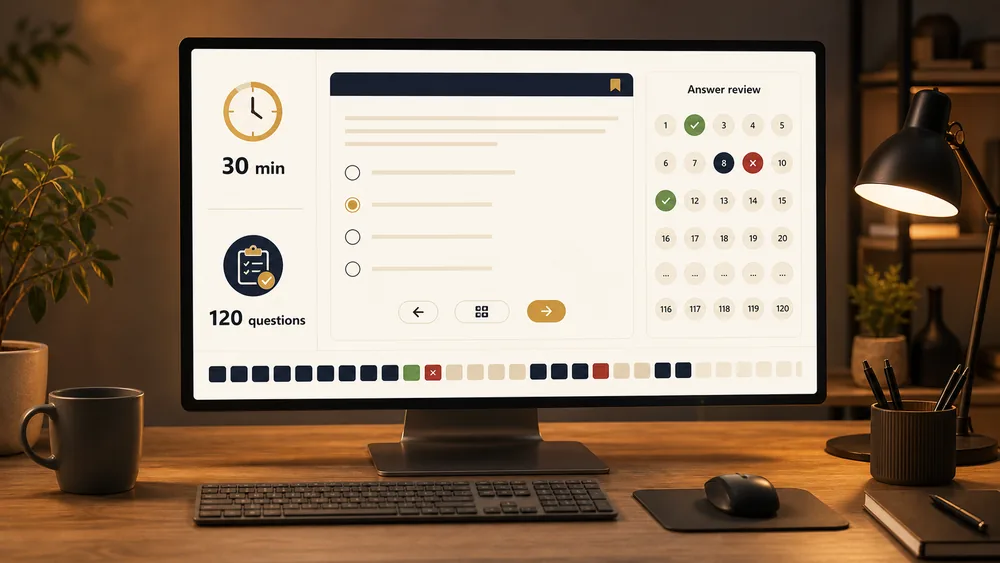
Detailed assessment
Use the 30-minute test when accuracy matters more than speed
The detailed version gives the broadest question sample on the page. It is designed for learners who want stronger evidence before choosing a course, tutor or study level.
With more questions, the test can check consistency across beginner, intermediate and advanced language choices.
Advanced learners often benefit from the longer version because higher levels are harder to separate with a short test. B2, C1 and C2 are not just more vocabulary. They involve control of nuance, register, complex sentence structure, collocation, implication and style. A 20-question test may not include enough advanced items to show those distinctions. A 120-question assessment has more room to include challenging language choices and reveal whether advanced accuracy is consistent.
What the 120-question test covers
The question bank is organized across the CEFR range. A1 and A2 questions check whether core building blocks are secure: common verbs, simple questions, basic negatives, everyday nouns, time phrases, prepositions, pronouns and short sentence patterns. B1 questions move toward independence, including present perfect meaning, past contrast, modals, conditional ideas, connected clauses and vocabulary used in familiar communication. B2 questions require greater flexibility with complex ideas, longer sentences and more precise word choice.
C1 and C2 questions focus on advanced control. They may involve subtle vocabulary differences, formal or informal register, complex grammar, inversion, concession, nominalization, collocation, idiomatic meaning or the ability to choose the most natural option in context. These questions are not included to make the test feel difficult for everyone. They are included because a full A1-C2 level test must have enough challenge to identify strong users as well as beginners.
Answer analysis
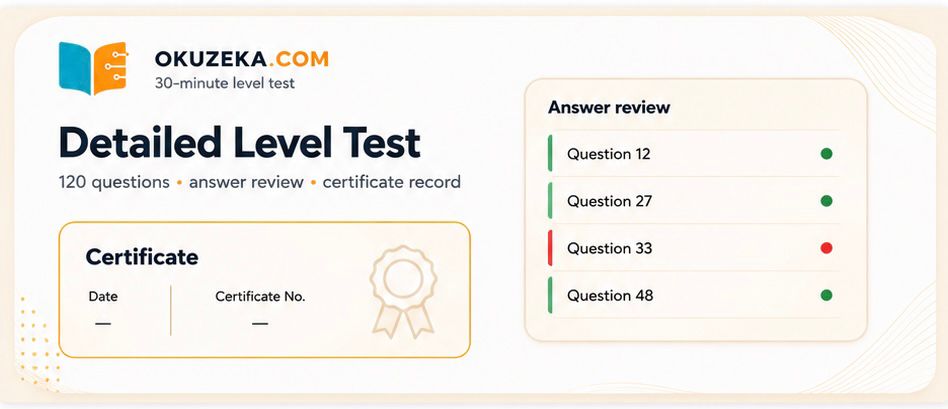
Detailed review makes the result easier to understand
The 30-minute test is not only about the final level label. The answer review helps you see correct answers, mistakes and empty responses after completion.
This is useful when you want to turn the result into a study plan instead of only reading one CEFR level estimate.
The test measures grammar and vocabulary directly. It does not directly measure live conversation, pronunciation, listening in noisy conditions, essay organization or the ability to respond spontaneously. Those skills require different tasks. However, grammar and vocabulary are still central to English development. A learner with a strong score usually has a useful foundation for reading, writing and structured communication. A learner with a lower score receives clear direction about what to study first.
Best use: choose the 30-minute detailed free English level test when placement accuracy matters more than speed and when you want the broadest online English level test with no sign up.
How to manage the timer
Thirty minutes is enough time for a careful attempt, but it still requires steady pacing. Do not rush through easy questions so quickly that you make careless mistakes. At the same time, do not spend several minutes on one unfamiliar item. A good strategy is to answer confident questions promptly, think carefully about medium questions and make a reasonable choice when a question is clearly outside your knowledge.
If you feel tired, remember that sustained attention is part of a detailed assessment. Longer tests show not only what you know in the first minute, but how consistently you can apply knowledge across a full session. This is useful for real learning. Reading an article, attending a class or completing a writing task also requires sustained focus.
Use the answer review after the test. Do not only look at the final level. The review can show whether mistakes cluster around tense, vocabulary, prepositions, articles, complex clauses or advanced word choice. Those clusters are more useful than a score alone because they tell you what to practise next.
Who should take the detailed test?
Take the 30-minute test if you are choosing a course level and want more confidence. It is also useful if your previous result felt surprising, if you are returning to English after several years, or if you are an intermediate learner trying to understand why progress has slowed. A plateau often means that some lower-level patterns are still unstable while the learner is trying to study advanced material.
Teachers can use the detailed test as an informal first indicator before a speaking interview or writing task. It provides a grammar and vocabulary profile that can guide follow-up questions. For example, if a learner scores near B2 but misses many conditionals or article questions, a teacher can target those areas during the first lessons.
Advanced learners can use it as a challenge. If you receive C1 or C2, treat the result as evidence of strong performance in this question set, then continue with demanding reading, writing, listening and speaking tasks. High-level improvement comes from precision and range, not simply from collecting more rules.
How to use the result for a study plan
If your result is A1, start with survival English: introductions, numbers, dates, family, work, simple descriptions and the verb forms needed for everyday communication. Build confidence with short, repeated practice. If your result is A2, expand routine communication. Practise past events, future plans, requests, directions, comparisons and short messages. A2 learners should aim for longer connected sentences without losing basic accuracy.
If your result is B1, begin using English as a tool. Read graded articles, watch learner-friendly videos, write paragraphs, speak about familiar topics and review recurring grammar errors. If your result is B2, move into more authentic material. Read full articles, listen to podcasts, practise opinions, write structured texts and pay attention to collocations. B2 learners often need to improve natural phrasing, not only grammar rules.
If your result is C1, refine precision. Work on academic or professional writing, subtle vocabulary, tone, style and complex argument. If your result is C2, keep challenging yourself with dense texts, varied accents, specialized topics and high-quality feedback. C2 is not the end of learning. It is a sign of highly developed control, and that control needs continued use.
Detailed test and certificate
After completing the 30-minute test, you can create an Okuzeka certificate with your estimated CEFR level, score and completion date. The certificate is written in English and designed as a formal-looking personal record. It is useful for a learner portfolio, class activity, self-study log or informal proof that you completed the online placement test.
The certificate is not an accredited exam result. This distinction is important. A detailed online test can provide a helpful estimate, but official institutions may require supervised testing under controlled conditions. If a university, employer, visa office or professional body requests language evidence, check its accepted tests directly. Use the Okuzeka certificate for learning documentation and motivation, not as a replacement for an official qualification.
Why detailed content helps search users
Users who search for “English A1 A2 B1 B2 C1 C2 level test,” “online English level test,” “free English level test” or “level test with certificate” often have different needs. Some want a fast score. Some want a serious placement guide. Some want to understand whether a certificate is included. The detailed 30-minute content answers those questions in one place, while the start button remains easy to find at the top of the window.
Good SEO content should not only repeat keywords. It should explain the test clearly, match the user’s search intent and help the learner make a better choice. This detailed section supports that goal by describing what the test measures, how to take it, how to interpret each CEFR band, when to use the certificate and when an official exam is required.
30-minute test FAQ
Is the 30-minute test the most accurate option?
It is the most detailed option on this page because it uses the largest question sample. It is still an estimated grammar and vocabulary placement, not a full official exam.
Can I stop halfway?
You should try to finish the full test. If time runs out, completed answers are evaluated, but a fuller attempt usually gives a more useful result.
Is it still no sign up?
Yes. You can start the 30-minute free English level test with no sign up. The optional certificate asks for your name only after the result.
Should I choose this before the quick test?
If you already know you want detail and you have 30 quiet minutes, yes. If you only want a first impression, start with the five-minute version and return later for the detailed test.
Final tips for the detailed assessment
Use the detailed result as a planning document. A 120-question test creates enough answer data to reveal patterns, so do not ignore the review section. If many mistakes are basic, return to foundations even if some advanced answers were correct. If basic and intermediate answers are strong but advanced questions are inconsistent, your next goal is probably precision rather than survival communication. This kind of reflection makes the detailed test more valuable than simply seeing a level badge.
For serious improvement, connect the CEFR estimate with real tasks. A learner aiming for B1 should practise connected descriptions, everyday problem solving and simple opinions. A learner aiming for B2 should practise longer explanations, natural listening, articles and structured writing. A learner aiming for C1 or C2 should work with demanding texts, careful editing, presentations, debate, academic vocabulary and professional communication. The test can point to the path, but regular use of English is what moves you along it.
Keep the certificate and score as a dated record. Then choose a realistic period of study before retesting. Four to eight weeks of steady practice is often more meaningful than repeating the test immediately. When you return, compare not only the score but also your confidence, speed, accuracy and ability to notice mistakes. The 30-minute free English level test no sign up is strongest when it becomes part of a larger cycle of learning, feedback and measurable progress.
How to interpret a detailed thirty-minute English assessment
The thirty-minute version is designed for learners who want the broadest sample on this page. A longer free English level test can explore more grammar structures, more vocabulary bands and more subtle differences between nearby CEFR levels. This matters especially when you are close to a boundary such as A2/B1, B1/B2 or B2/C1. A short result may point in the right direction, but a detailed test gives the system more evidence before estimating your level. That makes it useful before starting a serious course, returning to English after a long break, or checking whether advanced material is suitable.
To get a meaningful result, treat the thirty-minute window like a focused study appointment. Sit somewhere quiet, keep the same browser tab open and avoid dictionaries, translators or grammar websites. The purpose is not to look perfect; the purpose is to identify your current working level. If a sentence is difficult, use context clues and choose the answer that best fits the whole meaning. If you spend too long on one item, move forward. Consistent attention is part of what this longer online English level test measures.
After the result, read the level estimate as a placement guide. A1 and A2 results usually mean that controlled beginner or elementary material will build confidence fastest. B1 suggests you can begin working with connected texts and everyday conversation more independently. B2 often means authentic articles, podcasts and discussions are becoming realistic with support. C1 and C2 estimates suggest strong control of grammar and vocabulary, but advanced learners should still practise writing, speaking, listening to different accents and understanding complex style. A multiple-choice level test cannot fully measure every skill, so combine the result with real language tasks.
The thirty-minute version pairs well with the optional level test with certificate because the broader question sample makes the completion record feel more substantial. The certificate can be useful for personal tracking, tutor discussions or informal learning portfolios. It is still not an accredited qualification, and it should not be used where an official supervised exam is required. For learners who want a free English level test no sign up and a serious A1, A2, B1, B2, C1 or C2 placement estimate, this detailed window is the strongest option on the page.
Free English level test
Choose Your English Level Test
Free English level test, no sign up, no inbox treasure hunt. Pick the time you have and get an instant A1-C2 English level estimate with an optional certificate.
5 minutes · 20 questions5-minute English level test
Quick English Level Test
A fast English level test snapshot before your coffee gets cold.
Grammar and vocabulary
A1 to C2 English level estimate
Instant level test result
10 minutes · 40 questions10-minute English level test
English Level Test No Sign Up
A balanced free online English level test with less drama than a group project.
More reliable level sampling
All CEFR English levels
Certificate option
30 minutes · 120 questions30-minute English level test
Detailed English Level Test
The fullest English level test for a clearer picture of your skills, detective board not included.
Largest level test question set
Detailed A1-C2 placement
Review your English level test answers
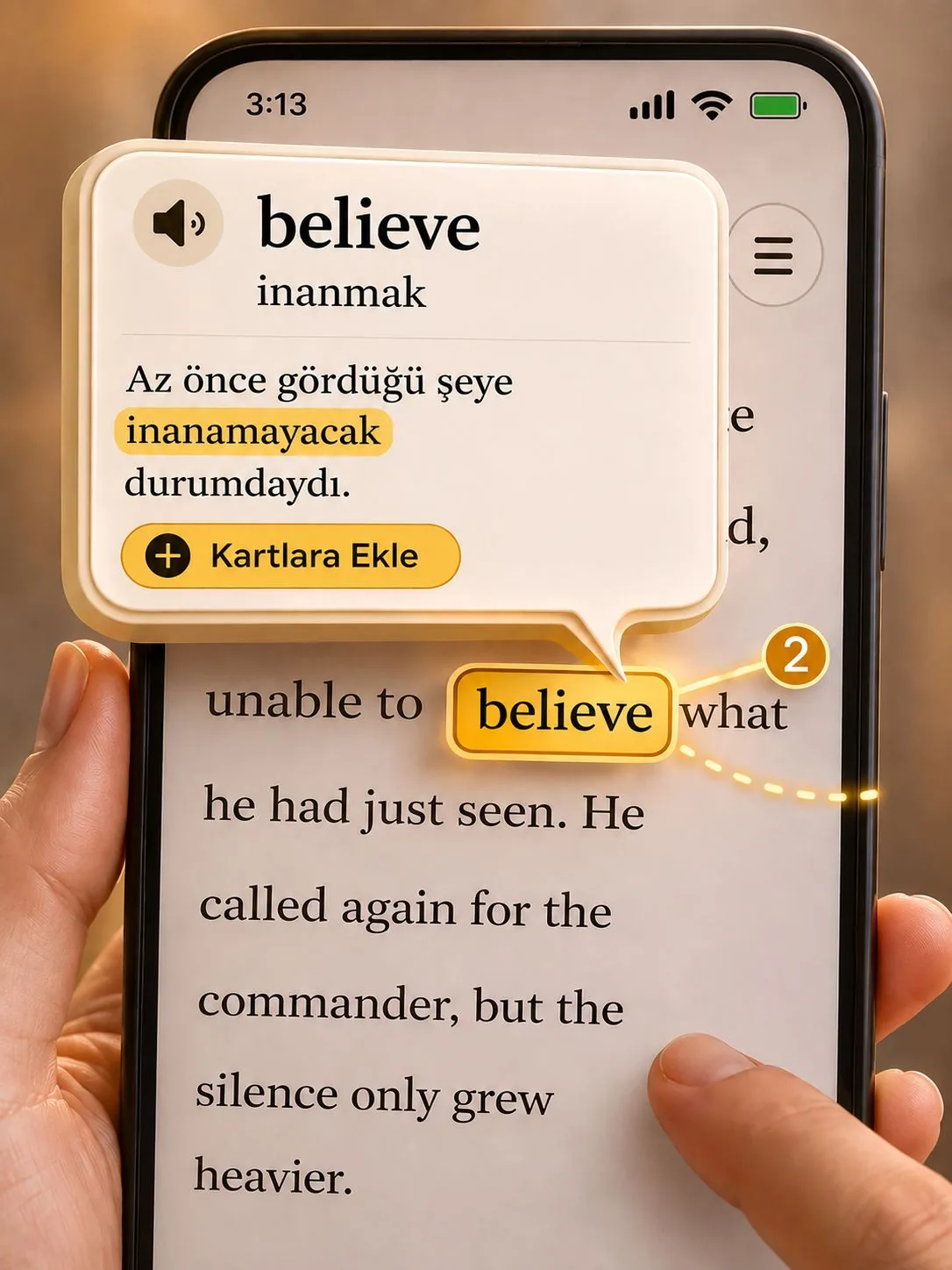
Tap to translate any word while reading
Tap to translate a word directly inside your book, article or PDF. Okuzeka reads the surrounding sentence and shows the meaning, translation and a short usage note when needed.
This keeps reading uninterrupted. You do not need to open a separate dictionary tab, copy text into another tool or leave the page just to understand what you are reading.
That means you understand not only the dictionary meaning of the word, but what the sentence is actually saying. The result is a more accurate, more readable and less disruptive learning experience.
English placement
English Level Test
Question 1 of 20
00:00
0/20 answered5 min
Your Okuzeka result
Your score will appear here.
Your estimated level--
Finish the test to see your result.
Score0
Correct0
Wrong0
Empty0
OKUZEKA
EXCELLENCE
IN ENGLISH
This award is presented by Okuzeka to
Student Name
in recognition of completing the Okuzeka English Placement Test with the estimated level
--
Congratulations on your hard work.
Understanding Your Free English Level Test Result
Your free online English level test result is a practical placement estimate based on the grammar and vocabulary questions you completed. The CEFR label helps you choose learning materials at an appropriate difficulty, but it does not describe every language skill. Reading, listening, speaking and writing can develop at different speeds.
What should you do after this result?
Use your estimated level as a starting point. Review the number of correct, wrong and empty answers, then choose a study plan that challenges you without making every task overwhelming.
How to use your A1-C2 placement
A1-A2: build high-frequency vocabulary, basic sentence patterns and confidence with everyday communication.
B1-B2: use longer texts, natural listening, regular conversation and structured writing to increase fluency and accuracy.
C1-C2: refine precision, style, collocations, register and specialized academic or professional language.
A short test is useful for orientation. If your score is close to a level boundary or the result feels unexpected, take the longer version after returning to the main page. The 30-minute assessment samples more questions and can provide a more detailed grammar and vocabulary picture.
About the English level certificate
You can create an Okuzeka certificate showing your estimated level, score and completion date. It is suitable as a personal learning record or informal portfolio item. It is not an accredited qualification and should not replace an official supervised examination when a university, employer or immigration authority requires verified proof.
Custom exam builder
Create Own Exam
Create your own exam with as many questions as you want. The original Okuzeka question bank will not be changed.
0 questions
Step 1 of 3
Set up your new exam
Choose how many questions the exam will have and how many minutes students will receive.
Upload Own Questions with JSONCreate your exam from one JSON file.
Use an object with exam settings and a questions array. The correct answer uses an index from 0 to 3: 0 = A, 1 = B, 2 = C, 3 = D.
Show JSON format example
{
  "examName": "Weekly Grammar Exam",
  "minutes": 15,
  "passScore": 60,
  "shuffle": true,
  "questions": [
    {
      "level": "A1",
      "text": "She __ to school every day.",
      "options": ["go", "goes", "going", "gone"],
      "answer": 1
    },
    {
      "level": "B1",
      "text": "Choose the correct sentence.",
      "options": ["I have seen it.", "I has seen it.", "I seeing it.", "I seen it."],
      "answer": 0
    }
  ]
}
No JSON file selected.
Step 2 of 3
Question 1 of 10
Complete every field before continuing.
Step 3 of 3
Review Your Exam
Check the exam details and every question before starting.
My English Exam0 questions · 0 minutes
Free Online English Level Test: Discover Your A1, A2, B1, B2, C1 or C2 Level
Take a free English level test with no sign up and find your current English level before choosing a course, lesson plan or study material. Knowing your level makes every next step easier: it helps you set realistic goals, measure progress and stop guessing. This online English level test gives you a practical estimate based on grammar and vocabulary questions across the Common European Framework of Reference for Languages, usually called the CEFR. You can choose the amount of time that suits you and see your result immediately after you finish.
Okuzeka offers three separate free English level test windows. The 5-minute quick test contains 20 questions and is designed for a fast first impression. The 10-minute standard test contains 40 questions and gives the system a broader sample of your knowledge. The 30-minute detailed assessment contains 120 questions and is the best choice when you want a more complete English A1 A2 B1 B2 C1 C2 level test. Every option works online, requires no sign up and includes the opportunity to create a personal level test certificate after the result.
Important: this is a placement estimate, not an official language qualification. Use the result to guide your learning plan. Universities, employers and immigration authorities may require a supervised examination from an approved provider.
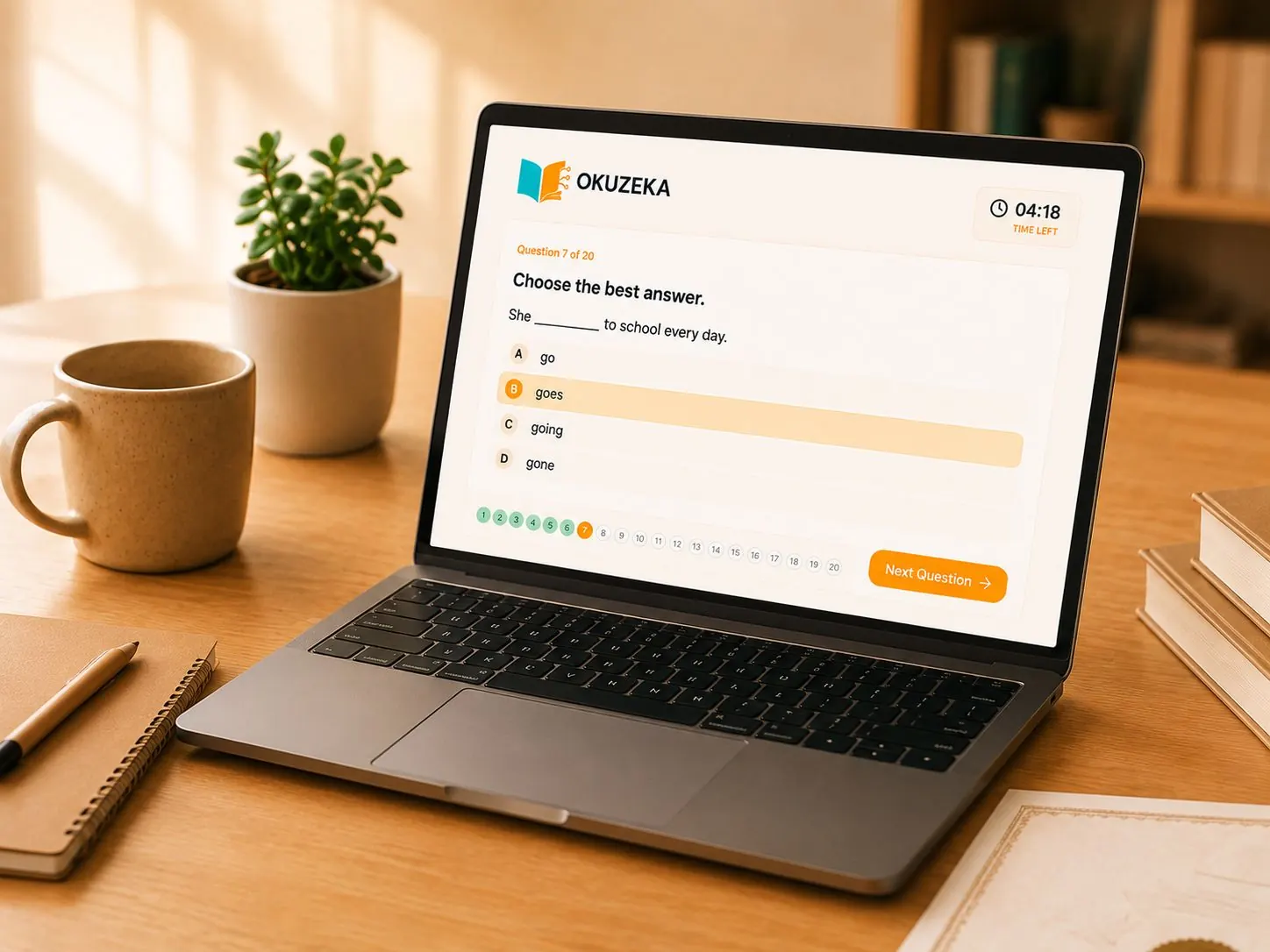
Online English level test preview
Visual guide
Check your English level in a clear online test
This free English level test is designed to feel simple before you start: choose 5, 10 or 30 minutes, answer grammar and vocabulary questions, then see an instant A1-C2 estimate.
The optional certificate gives you a clean personal record after the result, while the test itself stays fast, browser-based and no sign up.
How the Online English Level Test Works
The test draws questions from a large bank and presents them in a timed sequence. Questions cover common grammatical structures, word choice, sentence meaning and vocabulary used at different stages of English learning. Early items may check basic forms such as the verb “to be,” simple present sentences, articles and everyday words. Later items gradually move toward more demanding structures, precise vocabulary, complex clauses, advanced collocations and distinctions that proficient users are expected to understand.
When you choose a test window, the timer begins and the first question appears. Select the answer that you believe is correct. The test automatically moves forward after an answer, although you can also use the navigation controls. Your progress bar shows how much of the assessment is complete. If time ends before every question has been answered, the completed responses are still evaluated. For the most useful estimate, work steadily and answer as many items as you can without consulting a dictionary, translator, grammar website or another person.
Your score is calculated from correct answers, while unanswered and incorrect responses are shown separately. The system then compares the result with its placement ranges and returns an estimated CEFR level from A1 to C2. Because a short online test cannot fully measure speaking, listening, pronunciation and extended writing, the result should be understood as a grammar and vocabulary placement indicator. It is especially useful for choosing a starting point and identifying whether a course or learning resource is likely to be too easy, suitable or too difficult.
Free English level test
Discover your English level in a few minutes
Choose a quick, standard or detailed online English level test according to the time you have available. Each option checks grammar and vocabulary across the A1, A2, B1, B2, C1 and C2 range.
No sign up is required. Complete the questions in your browser, receive an instant placement estimate and use the result to choose a more suitable learning path.
Which Test Should You Choose: 5, 10 or 30 Minutes?
The 5-minute quick free English level test
Choose the 5-minute free English level test when you want a rapid answer and have limited time. Its 20 questions sample several difficulty levels, so it can identify a general range without making you complete a long assessment. This option works well before browsing study materials, comparing course levels or checking whether your English may have improved since a previous attempt. It is also friendly for mobile users who want to finish during a short break.
A quick test is convenient, but its smaller number of questions means that every response has more influence on the final estimate. A lucky guess or a momentary mistake can move the result more than it would in a longer assessment. If the displayed level surprises you, take the 10-minute or 30-minute version for a broader measurement. You can repeat the free English level test with no sign up.
The 10-minute standard free English level test
The 10-minute window contains 40 questions and offers a useful balance between speed and coverage. It is the recommended choice for most learners. Forty items allow the test to sample more grammar points and vocabulary bands while remaining short enough to complete in one focused session. Use this option if you are deciding between course levels, planning a new study routine or looking for a dependable starting estimate before speaking with a teacher.
Because the standard test includes twice as many questions as the quick version, an isolated mistake has less impact. You also have more opportunities to demonstrate what you know across the CEFR scale. Set aside ten quiet minutes, close distracting tabs and complete the assessment in one sitting. When the result appears, review the correct, wrong and empty counts before focusing on the level label.
The 30-minute detailed English assessment
The 30-minute test uses 120 questions and provides the widest coverage available on this page. Choose it when accuracy matters more than speed and when you can concentrate without interruption. The detailed version can explore a larger variety of structures, meanings and vocabulary choices, making the result less dependent on a small group of questions. It is the strongest option for learners returning to English after a long break, advanced students comparing B2 and C1 performance, or anyone who wants a more substantial challenge.
A longer test also measures consistency and sustained attention. Do not rush merely because a timer is visible. Read the complete sentence, consider the context and choose the best answer. If one question feels unfamiliar, make your best decision and continue rather than losing several minutes. The purpose is to capture your overall working knowledge, not to achieve perfection on every item.
Choose your test
5, 10 or 30-minute English level test
Use the 5-minute test for a quick first check, the 10-minute test for a balanced result or the 30-minute test for the broadest question sample. All three options provide an instant A1-C2 estimate.
After finishing, you can review your answers and create an optional Okuzeka completion certificate as a personal learning record.
English A1, A2, B1, B2, C1 and C2 Levels Explained
The CEFR provides a shared way to describe language ability. Schools, teachers, publishers and examination providers use its six main levels to organize courses and learning objectives. A level is not simply a list of grammar rules. It represents what a learner can generally understand and do in real situations. The descriptions below can help you interpret your online English level test result and choose an appropriate next goal.
A1 English level: beginner
At A1, learners can recognize and use familiar words and basic expressions. They may introduce themselves, give simple personal information, understand numbers and dates, and communicate about immediate needs when another person speaks slowly and clearly. Grammar typically includes the verb “to be,” subject pronouns, basic questions, common nouns, simple present forms and elementary prepositions. If your estimate is A1, focus on building a dependable foundation instead of trying to memorize advanced rules too early.
Useful A1 study activities include short daily vocabulary sessions, listening to clear beginner dialogues, reading labels and simple messages, and practising small sentence patterns aloud. Repetition matters. Learning a few common words deeply, including their pronunciation and use in sentences, is more valuable than collecting hundreds of isolated translations. A structured beginner course can help you connect vocabulary, grammar, listening and speaking.
A2 English level: elementary
At A2, learners can understand frequently used expressions about everyday topics such as family, shopping, work, local places and routines. They can exchange simple information, describe parts of their background and write short notes or messages. Grammar often expands to past events, future plans, countable and uncountable nouns, comparisons, frequency expressions and a wider range of questions. Communication is still limited, but the learner can manage many predictable situations.
If your result is A2, work toward longer connected sentences. Read graded stories, listen to short conversations more than once and keep a simple journal about your day. Review irregular past forms and practise language for requests, directions and plans. Moving from A2 to B1 usually requires a larger active vocabulary and more confidence using English without translating every phrase word by word.
B1 English level: intermediate
A B1 user can understand the main points of clear language about familiar matters and deal with many situations while travelling. They can produce connected text about personal interests, explain experiences and briefly give reasons for opinions or plans. B1 grammar may include present perfect forms, conditionals, relative clauses, reported ideas, passive constructions and modal verbs used with increasing flexibility. Mistakes remain common, yet meaning is usually clear.
B1 is an important independence level. Learners should begin using English as a tool, not only as a school subject. Watch accessible videos with English subtitles, read news written for learners, join conversations and write paragraphs that connect several ideas. Notice recurring mistakes and correct patterns, but do not allow fear of errors to stop communication. To reach B2, develop range, fluency and precision together.
B2 English level: upper intermediate
At B2, users can understand the main ideas of complex material, including technical discussion in a familiar field. They can interact with enough fluency and spontaneity for regular communication and can produce clear, detailed text on many topics. They can explain viewpoints, compare advantages and disadvantages, and follow more natural speech. Grammar knowledge is broader and more reliable, although subtle errors and awkward choices may still appear.
A B2 estimate often means that authentic English materials are within reach. Read full articles and novels suited to your interests, follow podcasts, participate in extended discussions and practise formal as well as informal writing. Pay attention to collocations, register and natural linking phrases rather than studying grammar in isolation. If you need English for university or professional work, begin practising tasks that resemble those real demands.
C1 English level: advanced
A C1 user can understand demanding texts, recognize implicit meaning and express ideas fluently without obvious searching for words. They can use language flexibly for social, academic and professional purposes and create clear, well-structured writing about complex subjects. At this stage, progress depends increasingly on precision: choosing the most natural expression, controlling tone, organizing information and understanding cultural or contextual implications.
If your test result is C1, challenge yourself with varied sources and unfamiliar subjects. Compare arguments in long-form journalism, analyse presentations, write for different audiences and request detailed feedback from proficient speakers or teachers. Build specialized vocabulary connected with your goals while continuing to refine everyday language. Advanced learners benefit from noticing small differences in connotation and style that basic vocabulary lists rarely explain.
C2 English level: proficient
C2 represents highly developed comprehension and expression. A proficient user can understand almost everything heard or read, combine information from different sources, reconstruct arguments and express subtle shades of meaning with precision. C2 does not mean knowing every English word or never making a mistake. It describes exceptional functional control across a wide range of situations, including dense, abstract and specialized communication.
An online multiple-choice assessment can suggest C2-level grammar and vocabulary performance, but a complete C2 evaluation requires demanding speaking, listening, reading and writing tasks. If you receive this estimate, treat it as evidence that the current question set was handled very strongly. Continue developing through complex real-world work, extensive reading, careful writing and interaction with diverse speakers.
How to Prepare for an English Placement Test
You do not need to study immediately before taking a placement test. In fact, last-minute memorization can make the result less representative of your normal ability. The best preparation is practical: choose a quiet place, use a stable device, allow enough uninterrupted time and make sure you understand how the test works. Select the 5, 10 or 30-minute window before you begin so that you are not forced to stop halfway through.
Answer independently. A translation tool may help you get a higher score, but it prevents the assessment from identifying the right learning level. Read every option, because several answers may appear grammatically possible while only one fits the full meaning. Use context clues, eliminate choices that clearly do not work and move forward when uncertain. A placement test should reveal gaps as well as strengths.
If English text is difficult to see on a small screen, rotate the device or use a larger display. Learners who need accessibility support can take additional time through an appropriate supervised assessment; this page uses fixed time windows for convenience. Feeling nervous is normal, but the result is not a judgment. It is simply information that can help make future learning more efficient.
How to Understand Your English Level Test Result
Start with the estimated level, then examine the score details. The number of correct answers indicates demonstrated knowledge in this question set. Wrong answers may show topics to review, while empty answers can reflect time pressure as well as difficulty. Two learners with the same estimated level may have different strengths, so avoid treating a single label as a complete description of your English.
Results near a level boundary should be interpreted cautiously. For example, a learner placed at B1 may already show some B2 knowledge but need greater consistency. Language ability also varies by skill. Someone may read at B2, speak at B1 and write at A2. Grammar and vocabulary questions cannot directly measure pronunciation, conversational interaction, listening under natural conditions or the organization of a long essay.
For a more rounded picture, combine this test with a short speaking sample, a listening activity and a writing task reviewed by a qualified teacher. If you take the assessment again, wait until you have completed a meaningful period of study. Repeating it immediately may measure memory of the questions rather than genuine improvement. Keep the date and result so that future comparisons remain useful.
Level Test with Certificate
After finishing the assessment, you can enter your name and create an Okuzeka certificate that displays your estimated CEFR level, placement score and completion date. No registration is required. The certificate offers a convenient personal record and can motivate learners by marking the completion of a study milestone. You can save it as a PDF using the print option available in your browser.
The certificate is not an accredited qualification and should not be presented as official proof where a verified examination is required. Employers, universities, visa authorities and professional organizations may specify accepted tests and minimum scores. Always check their current requirements directly. The Okuzeka certificate is best used for personal learning, informal portfolios, classroom activities and conversations with tutors about an appropriate starting level.
What to Do After You Know Your English Level
Turn the result into a small, specific plan. If you are A1 or A2, prioritize high-frequency vocabulary, basic sentence patterns and clear listening materials. If you are B1 or B2, expand your exposure to authentic English and practise producing longer speech and writing. At C1 or C2, focus on precision, style, specialized language and difficult tasks related to your academic, professional or personal interests.
A balanced weekly plan should include input and output. Input means reading and listening; output means speaking and writing. Add focused review of vocabulary and grammar, but connect new language to meaningful examples. Twenty minutes of concentrated practice on most days is often more sustainable than a long session once a month. Record what you study and review it at spaced intervals so that useful language moves into long-term memory.
Choose resources at the right difficulty. Material should challenge you without making every sentence a puzzle. Graded readers and learner podcasts are excellent at lower levels. Intermediate learners can mix adapted content with selected authentic sources. Advanced learners should vary genres, accents and topics. When a resource feels too easy for several weeks, increase the challenge; when it is constantly overwhelming, step back and build missing foundations.
Set goals based on actions, not vague hopes. “Improve my English” is difficult to measure. “Finish one B1 reader this month,” “write two 150-word texts each week,” or “hold a ten-minute conversation without switching languages” gives you a clear target. Retake an English level test after consistent study and compare the result with other evidence, such as easier reading, stronger listening comprehension or more confident communication.
Frequently Asked Questions
Is this a free English level test no sign up?
Yes. Choose the 5-minute, 10-minute or 30-minute test window, review its description and select the start button. No sign up is required.
Can I take the free English level test with no sign up?
Yes. The test does not require an account, email address or password. Your name is requested only if you decide to create the optional certificate after finishing.
Does the test cover every English level?
The question bank covers the CEFR range from A1, A2, B1 and B2 through C1 and C2. The system uses your performance to provide an estimated placement level.
Which test duration gives the best result?
The 30-minute assessment has the broadest question sample and is generally the strongest option for detail. The 10-minute test offers a practical balance for most people. The 5-minute version is intended as a quick check.
Can I use a phone or tablet?
Yes. The page is responsive and the test windows, questions, results and certificate form adapt to smaller screens. Use a stable browser and keep the page open until you finish.
Can I retake the online English level test?
Yes. You can start a new test after viewing your result. For progress measurement, study for several weeks before retaking so the comparison reflects learning rather than short-term memory.
Is the certificate official?
No. It records an estimated result from this online placement test. It is not a supervised or accredited language qualification. Check the rules of any institution that requests formal evidence.
Why might my result differ from another test?
Tests use different questions, scoring systems, time limits and skill combinations. Your concentration and familiarity with the topics can also affect performance. Consider several forms of evidence when making important decisions.
Start Your Free English Level Test
You now have three clear choices. Open the 5-minute window for a fast level check, choose the 10-minute window for a balanced standard test, or take the 30-minute window for the most detailed assessment on this page. This is a free English level test no sign up, and your A1-C2 estimate appears immediately. Return to the test cards above, choose your time and discover the next sensible step in your English learning journey.
?
Leave this test?
Your current answers and remaining time will be lost. Are you sure you want to exit?